Pools: Ratios of Motion to Motion as Complex Conjugates of C


Τὰ πάντα ῥεῖ καὶ οὐδὲν μένει is a Greek phrase that translates to Everything changes and nothing remains still". It is a famous quote by the Greek philosopher Heraclitus (540 BCE). [1]
Explanation [1]
Tà πάντα ῥεῖ καὶ οὐδὲν μένει is a central tenet of Heraclitus' philosophy,
the ideas of impermanence and the unity of opposites.
Heraclitus believed that change is the only constant,
and that everything is connected and not connected.
He also believed that there is something
that governs all change,
which he called "Logos".
Heraclitus is also known for his views on the sun, rivers, and day and night.
He believed that the sun is new each day, and that it never sets.
He also believed that the sun is in charge of the seasons. [4]
Generative AI is experimental.
[1] https://artof01.com/vrellis/works/AllAndOne.html
[2] https://en.wikiquote.org/wiki/Heraclitus
[3] https://www.informationphilosopher.com/solutions/philosophers/heraclitus/
[4] https://en.wikipedia.org/wiki/Heraclitus
Translation results
Translation result
 |
| Boltz man Bi cycle |
A Dynamical Theory of the Electromagnetic Field
[edit]In 1865 Maxwell published "A dynamical theory of the electromagnetic field" in which he showed that light was an electromagnetic phenomenon. Confusion over the term "Maxwell's equations" sometimes arises because it has been used for a set of eight equations that appeared in Part III of Maxwell's 1865 paper "A dynamical theory of the electromagnetic field", entitled "General equations of the electromagnetic field",[26] and this confusion is compounded by the writing of six of those eight equations as three separate equations (one for each of the Cartesian axes), resulting in twenty equations and twenty unknowns.[a]
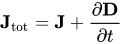
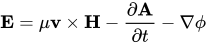
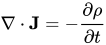
The eight original Maxwell's equations can be written in the modern form of Heaviside's vector notation as follows:
[A] The law of total currents [B] The equation of magnetic force [C] Ampère's circuital law [D] Electromotive force created by convection, induction, and by static electricity. (This is in effect the Lorentz force) [E] The electric elasticity equation [F] Ohm's law [G] Gauss's law [H] Equation of continuity or





- Notation
- H is the magnetizing field, which Maxwell called the magnetic intensity.
- J is the current density (with Jtot being the total current including displacement current).[b]
- D is the displacement field (called the electric displacement by Maxwell).
- ρ is the free charge density (called the quantity of free electricity by Maxwell).
- A is the magnetic potential (called the angular impulse by Maxwell).
- E is called the electromotive force by Maxwell. The term electromotive force is nowadays used for voltage, but it is clear from the context that Maxwell's meaning corresponded more to the modern term electric field.
- ϕ is the electric potential (which Maxwell also called electric potential).
- σ is the electrical conductivity (Maxwell called the inverse of conductivity the specific resistance, what is now called the resistivity).
Equation [D], with the μv × H term, is effectively the Lorentz force, similarly to equation (77) of his 1861 paper (see above).
When Maxwell derives the electromagnetic wave equation in his 1865 paper, he uses equation [D] to cater for electromagnetic induction rather than Faraday's law of induction which is used in modern textbooks. (Faraday's law itself does not appear among his equations.) However, Maxwell drops the μ v × H term from equation [D] when he is deriving the electromagnetic wave equation, as he considers the situation only from the rest frame.
T
The speed of light divided by permeability is equal to permittivity.
- Speed of light (c) is a universal
- Permeability ((μ))
- is a measure of a magnetic field
- Permittivity { ε }
- is a measure of an electric field
These three quantities are related by the following equation:
C squared = 1 / ( με )
If you rearrange this equation, you can see that:
Light = Amplitude X Wavelength
Permeability 1256
Permittivity 8854
Dia electric measures
Per MIT me
relative to
Permit all
The energy of the molecule in

1.24 / λ
.png)


Comments
Post a Comment