In The Beginning of The Θε
Ιν τηε βεγιννινγ
ζ In the Be gin in G
There was L eye G Ht (hint Θ βαψκαρδσ)


Οργαν Ευσεδ
The aka Θε Eye
became The Or G anΔ Grinder
Or G anΔ Eyes in G
to be known now as
Organizing with a Zing
Ασ τηε ΕΥΕΣ
Multipl eieioh eye ied

and so it goes
the first organ
was the organ of eye one
an eye made of two circles
defining the square root of three
as ideas of Π
τηε Ratio of the
Rotund Spheroid Surrounding
Θε Ra Di En T
Eye of Ra
Defined by the Radius
Royally Rotating to
Print the King
Using a SticK
C then B came
The Sum of the Squares of
the Lines noticable as the Light
Gathered its all seeing self
To Get Her
separating the here from
the Θε There where The
Θε
always was
always is
all ways
will be
becoming
collections
of C

The Way C
comes to Know itself
is by Stretching Θε point
into A line
and
A+ΔΔ = in G
A bent to the idea where the
curve is visible
in every baλλ
When the Ball is all or
When the Ball is busted up into
Waves scribing parts of the Di
Now and Now again
to be known as the Di~scriber
the one who
marks
the vortices
Measures the arcs
Balances the Scales
Records the result


As The all seeing eye sees to Organs and Organization the
Light becomes darker
as waves are added creating the
perspective of depth
The Light becomes He~av~ier
creating the iΔea of light
where there is no wait
where there is no w known as eight
mis known as weight
This is the M of the spun
The Magnet of Sun The He
container where two is better than one
and one is always and all ways
interested in becoming two
The Way to Do this is
Find Her and Get Back Together
TO GET HEr
and to get her here
the wattage waiting to be spun
back into the fabric of the sun
a node now known to be found at the center of a
Sphere IC sin you ~oidal form
formed from the nodes of notion
now seen as motion when the organs
known as eyes fill the light
of the skies with reflection from below
where the weightier waves flow
to cycle up the glow as
recycle machines go back
to the future with the baggage
whatever it became need in G to be unwound
using sound
using light
using motion
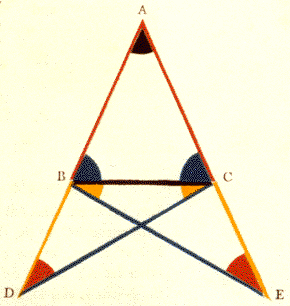
The fifth proposition in Book I of Euclid’s Elements states that the two base angles of an isosceles triangle are equal (in the figure angles B and C).
For 25 centuries and most likely twice as long, this result has been known as Pons Asinorum, Τhe Bridge of Asses, apparently a metaphor for a problem that separates light from the contained. Euclid proved the proposition by extending the sides AB and AC and drawing lines to form additional triangles extending the idea to the nth level of abstraction in the most concrete demonstration of self organization and in the end providing the language free system allOwing knowledge of the whOle to allOws for the h()l(O)graphic dismemberment of the whole into holons with which operations are to be or not to be performed to Re~turn in the flow of the solution as the next solution to the form observe~able as a solid crystal structure with the logic provided by the ability to count to two and keep track of the last thing one did as one became a holographic fragment of Θε Ονε all ways desperately disparately see ing and seeking Susan
to get back together working with the W He and closing the chapter with the end ending in N. Then

Historical Context
Originating from the Phoenician letter *Nun*, Nu has been a part of the Greek alphabet for centuries. It is equivalent to the Latin letter 'N'.
For instance, the Greek word for 'ship', which is ναῦς (naus), begins with the letter Nu.


.png)

Comments
Post a Comment