forcing the issue

Energy (from Ancient Greek ἐνέργεια (enérgeia) 'activity') is the quantitative property that is transferred to a body or to a physical system, recognizable in the performance of work and in the form of heat and light. Energy is a conserved quantity—the law of conservation of energy states that energy can be converted in form, but not created or destroyed; matter and energy may also be converted to one another. The unit of measurement for energy in the International System of Units (SI) is the joule (J).
Forms of energy include the kinetic energy of a moving object, the potential energy stored by an object (for instance due to its position in a field), the elastic energy stored in a solid object, chemical energy associated with chemical reactions, the radiant energy carried by electromagnetic radiation, the internal energy contained within a thermodynamic system, and rest energy associated with an object's rest mass.
All living organisms constantly take in and release energy. The Earth's climate and ecosystems processes are driven primarily by radiant energy from the sun.[1] The energy industry provides the energy required for human civilization to function, which it obtains from energy resources such as fossil fuels, nuclear fuel, renewable energy, and geothermal energy.

The siemens (symbol: S) is the unit of electric conductance, electric susceptance, and electric admittance in the International System of Units (SI). Conductance, susceptance, and admittance are the reciprocals of resistance, reactance, and impedance respectively; hence one siemens is equal to the reciprocal of one ohm (Ω−1) and is also referred to as the mho. The siemens was adopted by the IEC in 1935,[1] and the 14th General Conference on Weights and Measures approved the addition of the siemens as a derived unit in 1971.[2]
The unit is named after Ernst Werner von Siemens. In English, the same word siemens is used both for the singular and plural.[3] Like other SI units named after people, the symbol (S) is capitalized but the name of the unit is not. For the siemens this distinguishes it from the second, symbol (lower case) s.
The related property, electrical conductivity, is measured in units of siemens per metre (S/m).

The ohm is defined as an electrical resistance between two points of a conductor when a constant potential difference of one volt (V), applied to these points, produces in the conductor a current of one ampere (A), the conductor not being the seat of any electromotive force.[1]

Inductance is the tendency of an electrical conductor to oppose a change in the electric current flowing through it. The electric current produces a magnetic field around the conductor. The magnetic field strength depends on the magnitude of the electric current, and follows any changes in the magnitude of the current. From Faraday's law of induction, any change in magnetic field through a circuit induces an electromotive force (EMF) (voltage) in the conductors, a process known as electromagnetic induction. This induced voltage created by the changing current has the effect of opposing the change in current. This is stated by Lenz's law, and the voltage is called back EMF.
Inductance is defined as the ratio of the induced voltage to the rate of change of current causing it.[1] It is a proportionality constant that depends on the geometry of circuit conductors (e.g., cross-section area and length) and the magnetic permeability of the conductor and nearby materials.[1] An electronic component designed to add inductance to a circuit is called an inductor. It typically consists of a coil or helix of wire.
The term inductance was coined by Oliver Heaviside in May 1884, as a convenient way to refer to "coefficient of self-induction".[2][3] It is customary to use the symbol for inductance, in honour of the physicist Heinrich Lenz.[4][5] In the SI system, the unit of inductance is the henry (H), which is the amount of inductance that causes a voltage of one volt, when the current is changing at a rate of one ampere per second.[6] The unit is named for Joseph Henry, who discovered inductance independently of Faraday.[7]

Capacitance is the ability of a material object or device to store electric charge. It is measured by the charge in response to a difference in electric potential, expressed as the ratio of those quantities. Commonly recognized are two closely related notions of capacitance: self capacitance and mutual capacitance.[1]: 237–238 An object that can be electrically charged exhibits self capacitance, for which the electric potential is measured between the object and ground. Mutual capacitance is measured between two components, and is particularly important in the operation of the capacitor, an elementary linear electronic component designed to add capacitance to an electric circuit.
The capacitance between two conductors depends only on the geometry; the opposing surface area of the conductors and the distance between them; and the permittivity of any dielectric material between them. For many dielectric materials, the permittivity, and thus the capacitance, is independent of the potential difference between the conductors and the total charge on them.
The SI unit of capacitance is the farad (symbol: F), named after the English physicist Michael Faraday.[2] A 1 farad capacitor, when charged with 1 coulomb of electrical charge, has a potential difference of 1 volt between its plates.[3] The reciprocal of capacitance is called elastance.
Historically: the farad was regarded as an inconveniently large unit and the range of capacitors encountered would range from a few picofarads to a few thousand microfarads.[4] More recent developments in dielectric materials has permitted the manufacture of many types of capacitor of up to (as of 2024) a few thousand farads in reasonable physical sizes.[5] These are usually described as 'supercapacitors'.
Electromagnetic or magnetic induction is the production of an electromotive force (emf) across an electrical conductor in a changing magnetic field.
Michael Faraday is generally credited with the discovery of induction in 1831, and James Clerk Maxwell mathematically described it as Faraday's law of induction. Lenz's law describes the direction of the induced field. Faraday's law was later generalized to become the Maxwell–Faraday equation, one of the four Maxwell equations in his theory of electromagnetism.
Where is the electricity in a permanenT
Magnet ?
Where is the Magnetism in
Static Elctricity
?
?Magnetism is static electricity?
? Static electricity is Moving Magnetism
moon shot
spot the hair of the
floaters in the space
where the air is rarefied
In electrical circuits, reactance is the opposition presented to alternating current by inductance and capacitance.[1] Along with resistance, it is one of two elements of impedance; however, while both elements involve transfer of electrical energy, no dissipation of electrical energy as heat occurs in reactance; instead, the reactance stores energy until a quarter-cycle later when the energy is returned to the circuit. Greater reactance gives smaller current for the same applied voltage.
Reactance is used to compute amplitude and phase changes of sinusoidal alternating current going through a circuit element. Like resistance, reactance is measured in ohms, with positive values indicating inductive reactance and negative indicating capacitive reactance. It is denoted by the symbol . An ideal resistor has zero reactance, whereas ideal reactors have no shunt conductance and no series resistance. As frequency increases, inductive reactance increases and capacitive reactance decreases.

Inductance is the tendency of an electrical conductor to oppose a change in the electric current flowing through it. The electric current produces a magnetic field around the conductor. The magnetic field strength depends on the magnitude of the electric current, and follows any changes in the magnitude of the current. From Faraday's law of induction, any change in magnetic field through a circuit induces an electromotive force (EMF) (voltage) in the conductors, a process known as electromagnetic induction. This induced voltage created by the changing current has the effect of opposing the change in current. This is stated by Lenz's law, and the voltage is called back EMF.
Inductance is defined as the ratio of the induced voltage to the rate of change of current causing it.[1] It is a proportionality constant that depends on the geometry of circuit conductors (e.g., cross-section area and length) and the magnetic permeability of the conductor and nearby materials.[1] An electronic component designed to add inductance to a circuit is called an inductor. It typically consists of a coil or helix of wire.
The term inductance was coined by Oliver Heaviside in May 1884, as a convenient way to refer to "coefficient of self-induction".[2][3] It is customary to use the symbol for inductance, in honour of the physicist Heinrich Lenz.[4][5] In the SI system, the unit of inductance is the henry (H), which is the amount of inductance that causes a voltage of one volt, when the current is changing at a rate of one ampere per second.[6] The unit is named for Joseph Henry, who discovered inductance independently of Faraday.[7]
A solenoid (/ˈsoʊlənɔɪd/[1]) is a type of electromagnet formed by a helical coil of wire whose length is substantially greater than its diameter,[2] which generates a controlled magnetic field. The coil can produce a uniform magnetic field in a volume of space when an electric current is passed through it.
André-Marie Ampère coined the term solenoid in 1823, having conceived of the device in 1820.[3] The French term originally created by Ampère is solénoïde, which is a French transliteration of the Greek word σωληνοειδὴς which means tubular.
The helical coil of a solenoid does not necessarily need to revolve around a straight-line axis; for example, William Sturgeon's electromagnet of 1824 consisted of a solenoid bent into a horseshoe shape (similarly to an arc spring).
Solenoids provide magnetic focusing of electrons in vacuums, notably in television camera tubes such as vidicons and image orthicons. Electrons take helical paths within the magnetic field. These solenoids, focus coils, surround nearly the whole length of the tube.
Electrical elastance is the reciprocal of capacitance. The SI unit of elastance is the inverse farad (F−1). The concept is not widely used by electrical and electronic engineers. The value of capacitors is invariably specified in units of capacitance rather than inverse capacitance. However, it is used in theoretical work in network analysis and has some niche applications at microwave frequencies.
The term elastance was coined by Oliver Heaviside through the analogy of a capacitor as a spring. The term is also used for analogous quantities in some other energy domains. It maps to stiffness in the mechanical domain, and is the inverse of compliance in the fluid flow domain, especially in physiology. It is also the name of the generalised quantity in bond-graph analysis and other schemes analysing systems across multiple domains.
The dalton or unified atomic mass unit (symbols: Da or u) is a unit of mass defined as 112 of the mass of an unbound neutral atom of carbon-12 in its nuclear and electronic ground state and at rest.[1][2] It is a non-SI unit accepted for use with SI. The atomic mass constant, denoted mu, is defined identically, giving mu = 112 m(12C) = 1 Da.[3]
This unit is commonly used in physics and chemistry to express the mass of atomic-scale objects, such as atoms, molecules, and elementary particles, both for discrete instances and multiple types of ensemble averages. For example, an atom of helium-4 has a mass of 4.0026 Da. This is an intrinsic property of the isotope and all helium-4 atoms have the same mass. Acetylsalicylic acid (aspirin), C
9H
8O
4, has an average mass of about 180.157 Da. However, there are no acetylsalicylic acid molecules with this mass. The two most common masses of individual acetylsalicylic acid molecules are 180.0423 Da, having the most common isotopes, and 181.0456 Da, in which one carbon is carbon-13.
The molecular masses of proteins, nucleic acids, and other large polymers are often expressed with the units kilodalton (kDa) and megadalton (MDa).[4] Titin, one of the largest known proteins, has a molecular mass of between 3 and 3.7 megadaltons.[5] The DNA of chromosome 1 in the human genome has about 249 million base pairs, each with an average mass of about 650 Da, or 156 GDa total.[6]
The mole is a unit of amount of substance used in chemistry and physics, which defines the mass of one mole of a substance in grams as numerically equal to the average mass of one of its particles in daltons. That is, the molar mass of a chemical compound is meant to be numerically equal to its average molecular mass. For example, the average mass of one molecule of water is about 18.0153 daltons, and one mole of water is about 18.0153 grams. A protein whose molecule has an average mass of 64 kDa would have a molar mass of 64 kg/mol. However, while this equality can be assumed for practical purposes, it is only approximate, because of the 2019 redefinition of the mole.[4][1]
n general, the mass in daltons of an atom is numerically close but not exactly equal to the number of nucleons in its nucleus. It follows that the molar mass of a compound (grams per mole) is numerically close to the average number of nucleons contained in each molecule. By definition, the mass of an atom of carbon-12 is 12 daltons, which corresponds with the number of nucleons that it has (6 protons and 6 neutrons). However, the mass of an atomic-scale object is affected by the binding energy of the nucleons in its atomic nuclei, as well as the mass and binding energy of its electrons. Therefore, this equality holds only for the carbon-12 atom in the stated conditions, and will vary for other substances. For example, the mass of an unbound atom of the common hydrogen isotope (hydrogen-1, protium) is 1.007825032241(94) Da,[a] the mass of a proton is 1.0072764665789(83) Da,[7] the mass of a free neutron is 1.00866491606(40) Da,[8] and the mass of a hydrogen-2 (deuterium) atom is 2.014101778114(122) Da.[9] In general, the difference (absolute mass excess) is less than 0.1%; exceptions include hydrogen-1 (about 0.8%), helium-3 (0.5%), lithium-6 (0.25%) and beryllium (0.14%).
The dalton differs from the unit of mass in the atomic units systems, which is the electron rest mass (me).
In particle physics, the electron mass (symbol: me) is the mass of a stationary electron, also known as the invariant mass of the electron. It is one of the fundamental constants of physics. It has a value of about 9.109×10⁻³¹ kilograms or about 5.486×10⁻⁴ daltons, which has an energy-equivalent of about 8.187×10⁻¹⁴ joules or about 0.511 MeV.[3]
Terminology
[editAn electric current is a flow of charged particles,[1][2][3] such as electrons or ions, moving through an electrical conductor or space. It is defined as the net rate of flow of electric charge through a surface.[4]: 2 [5]: 622 The moving particles are called charge carriers, which may be one of several types of particles, depending on the conductor. In electric circuits the charge carriers are often electrons moving through a wire. In semiconductors they can be electrons or holes. In an electrolyte the charge carriers are ions, while in plasma, an ionized gas, they are ions and electrons.[6]
In the International System of Units (SI), electric current is expressed in units of ampere (sometimes called an "amp", symbol A), which is equivalent to one coulomb per second. The ampere is an SI base unit and electric current is a base quantity in the International System of Quantities (ISQ).[7]: 15 Electric current is also known as amperage and is measured using a device called an ammeter.[5]: 788
Electric currents create magnetic forces, which are used in motors, generators, inductors, and transformers.[8][9] In ordinary conductors, they cause Joule heating, which creates light in incandescent light bulbs. Time-varying currents emit electromagnetic waves, which are used in telecommunications to broadcast information.[10]

ION
An ion (/ˈaɪ.ɒn, -ən/)[1] is an atom or molecule with a net electrical charge. The charge of an electron is considered to be negative by convention and this charge is equal and opposite to the charge of a proton, which is considered to be positive by convention. The net charge of an ion is not zero because its total number of electrons is unequal to its total number of protons.
A cation is a positively charged ion with fewer electrons than protons[2] (e.g. K+ (potassium ion)) while an anion is a negatively charged ion with more electrons than protons.[3] (e.g. Cl- (chloride ion) and OH- (hydroxide ion)). Opposite electric charges are pulled towards one another by electrostatic force, so cations and anions attract each other and readily form ionic compounds.
If only a + or - is present, it indicates a +1 or -1 charge (2+ indicates charge +2, 2- indicates charge -2).[4]
+2 and -2 charge look like this: Li2- (negative charge) He2+ (positive charge).
Ions consisting of only a single atom are termed atomic or monatomic ions, while two or more atoms form molecular ions or polyatomic ions. In the case of physical ionization in a fluid (gas or liquid), "ion pairs" are created by spontaneous molecule collisions, where each generated pair consists of a free electron and a positive ion.[5] Ions are also created by chemical interactions, such as the dissolution of a salt in liquids, or by other means, such as passing a direct current through a conducting solution, dissolving an anode via ionization.
For example, the relativistic expression for the total energy, E, of an electron moving at speed v iswhere

- c is the speed of light;
- γ is the Lorentz factor,
- me is the "rest mass", or more simply just the "mass" of the electron.
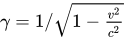
This quantity me is frame invariant and velocity independent. However, some texts[which?] group the Lorentz factor with the mass factor to define a new quantity called the relativistic mass, mrelativistic = γme.[citation needed]
.png)


Comments
Post a Comment