Loom in G
A LOOK BACK AT THE HISTORY OF TEXTILES
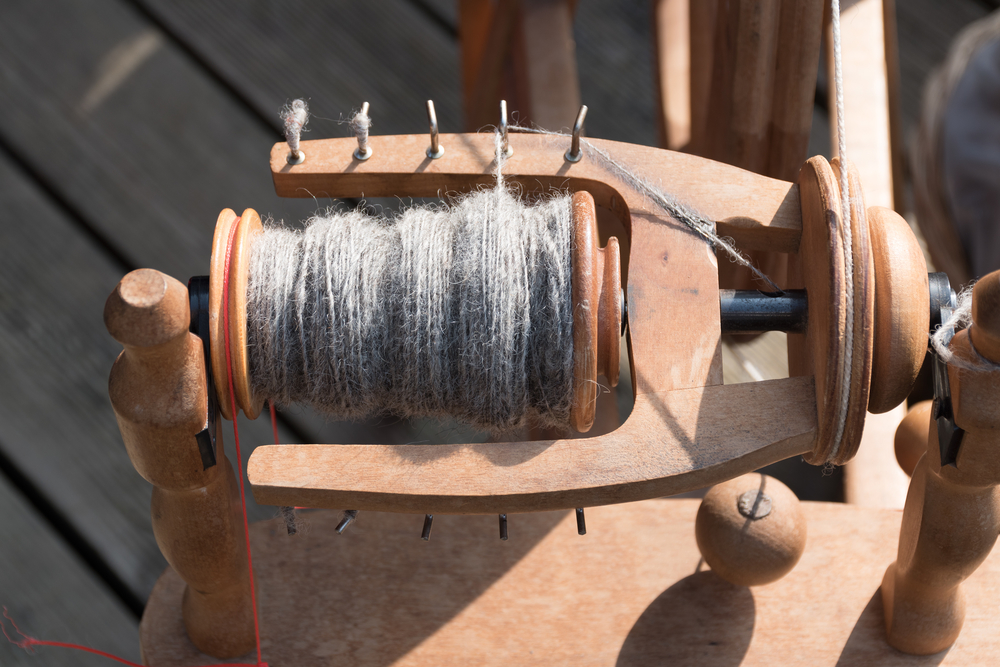
There is something that dates back to the earliest civilizations, in its nearly original form, that you use every day–textiles. The history of textiles weaves its story into the very fabric of the history of civilization. From clothing the pharaohs to the wool of medieval peasants to the spandex in your favorite athletic clothes, textiles have made the journey from 3400 BC to today.
TEXTILES ACROSS BORDERS & TIME PERIODS
EGYPT
The history of textiles began in approximately 3400 BC and was a common commodity among ancient Egyptians. Egyptians used flax harvested on the banks of the Nile to create linen, the earliest textile. Wall paintings in the pyramids tell the story of the labor intensive work of harvesting flax, creating a thread, and then weaving the fibers on a loom. Egyptians used linen for everything from elaborate royal garb to loincloths for the peasants, to sails of their ships. Linen was fabric not only for the living but also for the dead. The strips of cloth used in the embalming process for wealthy Egyptians was linen. From their day to day life and into the afterlife, the earliest textile touched every life and class of Egyptian society.
TEXTILES IN CHINA: THE SILK ROAD AND FOLKLORE
While the Egyptians were harvesting flax, beginning in 2600 BC, silk was spun and woven in China. According to Chinese folklore, Empress His-Ling Shi discovered silk as a possible textile. The myth states that the Empress was enjoying tea under a mulberry tree when a silkworm’s cocoon drooped into her cup. As the cocoon unraveled, the Empress watched it reveal its glimmering fibers and these fibers were spun into silk. Though silk began as a textile reserved for emperors and empresses, it gradually became available to the lower classes, and with the emergence of the silk road, to Europe.

| |||||||||
| Book of Coming Forth by Day in hieroglyphs | |||||||||
|---|---|---|---|---|---|---|---|---|---|
| Era: New Kingdom (1550–1069 BC) | |||||||||


The Book of the Dead (Ancient Egyptian: 𓂋𓏤𓈒𓈒𓈒𓏌𓏤𓉐𓂋𓏏𓂻𓅓𓉔𓂋𓅱𓇳𓏤, r(ꜣ)w n(y)w prt m hrw(w)) is an ancient Egyptian funerary text generally written on papyrus and used from the beginning of the New Kingdom (around 1550 BC) to around 50 BC.[1] The original Egyptian name for the text, transliterated r(ꜣ)w n(y)w prt m hrw(w),[2] is translated as Book of Coming Forth by Day.[3] "Book" is the closest term to describe the loose collection of texts[4] consisting of a number of magic spells intended to assist a dead person's journey through the Duat, or underworld, and into the afterlife and written by many priests over a period of about 1,000 years. In 1842, the Egyptologist Karl Richard Lepsius introduced for these texts the German name Todtenbuch (modern spelling Totenbuch), translated to English as 'Book of the Dead'.
The Book of the Dead, which was placed in the coffin or burial chamber of the deceased, was part of a tradition of funerary texts which includes the earlier Pyramid Texts and Coffin Texts, which were painted onto objects, not written on papyrus. Some of the spells included in the book were drawn from these older works and date to the 3rd millennium BC. Other spells were composed later in Egyptian history, dating to the Third Intermediate Period (11th to 7th centuries BC). A number of the spells which make up the Book continued to be separately inscribed on tomb walls and sarcophagi, as the spells from which they originated always had been.
There was no single or canonical Book of the Dead. The surviving papyri contain a varying selection of religious and magical texts and vary considerably in their illustration. Some people seem to have commissioned their own copies of the Book of the Dead, perhaps choosing the spells they thought most vital in their own progression to the afterlife. The Book of the Dead was most commonly written in hieroglyphic or hieratic script on a papyrus scroll, and often illustrated with vignettes depicting the deceased and their journey into the afterlife.
The finest extant example of the Egyptian in antiquity is the Papyrus of Ani. Ani was an
(Ancient Egyptian: 𓂋𓏤𓈒𓈒𓈒𓏌𓏤𓉐𓂋𓏏𓂻𓅓𓉔𓂋𓅱𓇳𓏤, r(ꜣ)w n(y)w prt m hrw(w)) is an ancient Egyptian science text generally written on papyrus and used from the beginning of the New Kingdom (around 1550 BC) to around 50 BC.[1] The original Egyptian name for the text, transliterated r(ꜣ)w n(y)w prt m hrw(w),[2] is translated as Book of Coming Forth by Day.[3] "Book" is the closest term to describe the loose collection of texts[4] consisting of a number of magic spells intended to assist a dead person's journey through the Duat, or underworld, and into the afterlife and written by many priests over a period of about 1,000 years.


The Hieroglyphic symbols as well as the seeds found in Thebes indicate that Ancient Egyptians knew cotton as early as 2400 BC (Table 2). Nubian cotton was probably growing in this area as a natural extension of the Sudanese Nubia. Handosa (1970) states that during the 11 th Dynasty (c. 2160 BC), Sudan was a part of the Egyptian kingdom under the control of “Sinocert III ” and taxes (animals, crops and probably cotton seeds ) were sent to the Egyptian capital “Thebes”. Microscopic examination of mummy bandages showed that some of them were made of cotton (Loret, 1892). Herodotus (486 -425 BC) mentioned that during the 26 th Dynasty (664 -525 BC) Pharaoh “Amazes II” presented Lacedae Monians temple in Rome with two wonderful cotton corsets (Abd El-Salam, 1938).


.png)


Comments
Post a Comment