Layers of Business business related


Old Kingdom (2686–2181 BC)

Major advances in architecture, art, and technology were made during the Old Kingdom, fueled by the increased agricultural productivity and resulting population, made possible by a well-developed central administration.[27] Some of ancient Egypt's crowning achievements, the Giza pyramids and Great Sphinx, were constructed during the Old Kingdom. Under the direction of the vizier, state officials collected taxes, coordinated irrigation projects to improve crop yield, drafted peasants to work on construction projects, and established a justice system to maintain peace and order.[28]

| 3rd 2686–2613 BC | Djoser | Pyramid of Djoser | Saqqara | 121×109 | 60 | 330,400 | 29°52′16.56″N 31°12′59.02″E[1] |  |
| 3rd | Sekhemkhet | Buried Pyramid | Saqqara | 120 | 7 | 33,600 (unfinished) | 29.866°N 31.213°E[2] Unfinished pyramid convered into a square mastaba. |  |
| 3rd | Khaba (uncertain) | Layer Pyramid | Zawyet el'Aryan | 84 | 20 | 47,040 (possibly unfinished) | 29.932820°N 31.161262°E[3] |  |
| 4th 2613–2498 BC | Sneferu | Pyramid of Meidum (Snefru endures) | Meidum | 144 | 65 | 638,733 (possibly unfinished) | 51° 50' 35"[4] |  |
| 4th | Sneferu | Bent Pyramid (Snefru shines in the South) | Dahshur | 188 | 105 | 1,237,040 | 54° 50' 35" /43° 22'[4] |  |
| 4th | Sneferu | Red Pyramid (Snefru shines in the North) | Dahshur | 220 | 105 | 1,694,000 | 43° 22' |  |
| 4th | Khufu | The Great Pyramid of Giza (Khufu's horizon) | Giza | 230.3 | 146.6 | 2,583,283 | 51° 50' 40"[5] |  |
| 4th | Djedefre | Pyramid of Djedefre (Djedefre's Starry Sky) | Abu Rawash | 106.2 | 67 | 131,043 (possibly unfinished) | ~52°[4][6] |  |
| 4th (uncertain) | Bikheris? | Northern Pyramid of Zawyet el'Aryan (Star of ..?..-Ka) | Zawyet el'Aryan | 200 | (Never built) | [8][9] |  | |
| 4th | Khafre | Pyramid of Khafre (Khafre is great) | Giza | 215.25 | 143.5 | 2,211,096 | 53°10'[4] |  |
| 4th | Menkaure | Pyramid of Menkaure (Menkaure is divine) | Giza | 103.4 | 65.5 | 235,183 | 51°20′25″[10] |  |
| 5th 2498–2345 BC | Userkaf | Pyramid of Userkaf (The pure sites of Userkaf) | Saqqara | 73.3 | 49 | 87,906 | 53°7'48"[4] |  |
| 5th | Sahure | Pyramid of Sahure (The personality (ba) of Sahure appears) | Abusir | 78.75 | 47 | 96,542 | 50°11'40"[4] |  |
| 5th | Neferirkare Kakai | Pyramid of Neferirkare (Personality (ba) of Neferirkare) | Abusir | 105 | 54 | 257,250 | 54°30'[11] |  |
| 5th | Neferefre | Pyramid of Neferefre (The power of Neferefre is divine) | Abusir | 65 | 29,575 (unfinished) | Unfinished pyramid convered into a square mastaba. |  | |
| 5th | Shepseskare | Unfinished pyramid of North Abusir | Abusir | 100 | Never built, earthwork just started | – | ||
| 5th | Nyuserre Ini | Pyramid of Nyuserre (The seats of Niuserre will endure) | Abusir | 79.9 | 51.68 | 112,632 | 51° 50' 35"[12] |  |
| 5th | Menkauhor Kaiu[13] | Headless Pyramid (The divine places of Menkauhor) | Saqqara | c. 52 | n.d. | n.d. | ||
| 5th | Djedkare Isesi | Pyramid of Djedkare-Isesi (Beautiful is Djedkare) | South Saqqara | 78.75 | 52.5 | 107,835 | 52°[14] |  |
| 5th | Unas | Pyramid of Unas (The places of Unas are beautiful) | North Saqqara | 57.75 | 43 | 47,390 | 56°[4] |  |
| 6th 2345–2181 BC | Teti | Pyramid of Teti (The places of Teti are enduring) | North Saqqara | 78.5 | 52.5 | 107,835 | 53° 7' 48"[15] |  |
| 6th | Pepi I | Pyramid of Pepi I (The beauty of Pepi may endure) | South Saqqara | 78.75 | 52.5 | 107,835 | 53° 7' 48"[16] | |
| 6th | Merenre | Pyramid of Merenre (The beauty of Merenre appears) | South Saqqara | 78.75 | 52.5 | 107,835 | 57°7'48" |  |
| 6th | Pepi II | Pyramid of Pepi II (Pepi is established and living) | South Saqqara | 78.75 | 52.5 | 107,835 | 53° 7' 48"[5] |  |
| 8th | Qakare Ibi | Pyramid of Ibi | South Saqqara | 31.5 | 21? | 53° 7′[17] |  | |
| First Intermediate Period | Khui | Pyramid of Khui | Dara | 146x136 | n.d. | n.d.[18] |  | |
| 10th | Merikare | Pyramid of Merikare (Flourishing are the abodes of Merikare) | Unknown, possibly North Saqqara | n.d. | n.d. | n.d.[19] | ||
| 12th 1991–1803 BC | Amenemhat I | Pyramid of Amenemhet I (Amenemhat appears at his place) | Lisht | 84 | 55 | 129,360 | 54° 27' 44" |  |
| 12th | Senusret I | Pyramid of Senusret I (Senusret beholds the two lands) | Lisht | 105 | 61.25 | 225,093 | 49° 24'[20] |  |
| 12th | Amenemhat II | White Pyramid (Amenemhat is provided) | Dahshur | 50 |  | |||
| 12th | Senusret II | Pyramid of Senusret II (Senusret appears) | El-Lahun | 106 | 48.6 | 185,665 | 42° 35'[21] |  |
| 12th | Senusret III | Pyramid of Senusret III | Dahshur | 105 | 78 | 288,488 | 56° 18' 35"[22] |  |
| 12th | Amenemhat III | Pyramid of Amenemhat III (Amenemhat is beautiful) | Dahshur | 105 | 75 | 274,625 | 56° 18' 35" |  |
| 12th | Amenemhat III | Pyramid of Hawara (Amenemhat lives) | Hawara | 105 | 58 | 200,158 | 48° 45' |  |
| 12th or 13th | Amenemhat IV (?) | Southern Mazghuna pyramid | South Mazghuna | 52.5 | (unfinished) | n.d. | n.d. |  |
| 12th or 13th | Sobekneferu (?) | Northern Mazghuna pyramid | North Mazghuna | >52.5 | (unfinished) | n.d. | n.d. |  |
| 13th c. 1790 BC | Ameny Qemau | Pyramid of Ameny Qemau | South Saqqara | 52 | 35 | c 55° |  | |
| 13th | Ameny Qemau (possibly usurped)[23] | n.d. | Dahshur | n.d. | n.d. | n.d. | ||
| 13th c. 1760 BC | Khendjer | Pyramid of Khendjer | South Saqqara | 52.5 | 37.35 | 34,300 | 55°[24] |  |
| 13th | unknown | Southern South Saqqara pyramid | South Saqqara | 78.75 | (unfinished) | n.d. | n.d. |  |
| 13th c. 1740 BC | Likely Neferhotep I | Tomb S9 | Abydos | uncertain | unknown | Likely a pyramid, similar to Khendjer's, but possibly a mastaba |  | |
| 13th c. 1730 BC | Likely Sobekhotep IV | Tomb S10 | Abydos | uncertain | unknown | Likely a pyramid, similar to Khendjer's, but possibly a mastaba |  | |
| 17th | Nubkheperre Intef | Pyramid of Nubkheperre Intef | Dra' Abu el-Naga' | 11 | 13 | n.d. | 60° | |
| 18th (1550–1292 BC) | Ahmose I | Pyramid of Ahmose | Abydos | 52.5 | 10 | n.d. | 60°[25] |  |

With the rising importance of central administration in Egypt, a new class of educated scribes and officials arose who were granted estates by the king in payment for their services. Kings also made land grants to their mortuary cults and local temples, to ensure that these institutions had the resources to worship the king after his death. Scholars believe that five centuries of these practices slowly eroded the economic vitality of Egypt, and that the economy could no longer afford to support a large centralized administration.[29] As the power of the kings diminished, regional governors called nomarchs began to challenge the supremacy of the office of king. This, coupled with severe droughts between 2200 and 2150 BC,[30] is believed to have caused the country to enter the 140-year period of famine and strife known as the First Intermediate Period.[31]
| Image | Name | Comments | Reign |
|---|---|---|---|
 | [...]pu[7] | Only known from the Palermo stone[8] | Unknown |
| Hsekiu / Seka | Only known from the Palermo stone[8] | Unknown |
| Khayu | Only known from the Palermo stone[9] | Unknown |
| Tiu / Teyew | Only known from the Palermo stone[10] | Unknown |
| Thesh / Tjesh | Only known from the Palermo stone[11] | Unknown |
| Neheb | Only known from the Palermo stone[12] | Unknown |
| Wazner | Only known from the Palermo stone[13] | Ruled around or earlier than 3200 BC |
| Mekh | Only known from the Palermo stone[14] | Unknown |
| [...]a[15] | Only known from the Palermo stone[14] | Unknown |
 | Hedju Hor | Only known from two clay jugs from Tura, Egypt | Naqada II?? |
 | Ny-Hor | Only known from clay and stone vessels found in tombs near Tarchan, Tura, Tarjan, and Nagada. Some scholars believe that this serekh is simply a crude attempt at writing the name "Narmer".[16] | Naqada II?? |
 | Ni-Neith | Only known from inscriptions in Helwan. Reading of name is uncertain.[17] | Naqada III?? |
 | Hat-Hor | Some scholars believe that this serekh is simply a crude attempt at writing the name "Narmer".[18] | Around 3180 BC |
 | [Double Falcon] | May also have ruled in Upper Egypt | Naqada III (32nd century BC) |
| Wash | Only known from the Narmer Palette[19] Around 3150 BC | Naqada III |

Image | Name | Comments | Dates |
|---|---|---|---|
 | [Crocodile] | Potentially read Shendjw; identity and existence are disputed.[26] | Around 3170 BC |
 | Iry-Hor | Correct chronological position unclear.[27] | Around 3170 BC |
 | Ka | Maybe read Sekhen rather than Ka. Correct chronological position unclear.[28] | Around 3170 BC |
 | [Scorpion II] | Potentially read Serqet; possibly the same person as Narmer.[29] | Around 3170 BC |
| Image | Name | Personal name | Comments | Dates |
|---|---|---|---|---|
 | Narmer | Menes? | Believed by many scholars to be the same person as Menes, due to the preponderance of evidence indicating this.[32] His name is widely attested across Egypt, and has also been found at Nahal Tillah in Israel, which is much farther afield than his predecessors.[33] | Around 3150 BC[31] |
 | Hor-Aha | Teti | Greek form: Athotís.[34] May also be Menes although Narmer is more likely.[32] Trade was largely replaced by direct exploitation of resources via outposts during his reign.[35] Possibly the son of Narmer. | Around 3125 BC |
 | Djer[36] | Itetj | Greek form: Kénkenes. His tomb was later thought to be the legendary tomb of Osiris. First pharaoh with a full Golden Horus name. Interest and trade with Egypt's North Eastern borders appears to have been renewed during Djer's reign.[35] | 54 years[37] |
 | Djet[38] | Ita | Greek form: Ouenephes. Indications show that Djet did not reign for long.[39] | 10 years[40] |
 | Merneith | — | Possibly the first female pharaoh of Egypt. She may have ruled as regent for her son Den. Her tomb is notable for being on the same scale as other tombs of other kings of that period. | Around 2950 BC |
 | Den[41] | Khasti | Greek form: Ousaphaidos. Den was the first pharaoh to have a Nesut-biti(dual king) name, and is the first pharaoh attested wearing the double crown (pschent) of upper and lower Egypt.[42] A second sed festival is attested from his reign, indicating he enjoyed a long time in power.[42] Den focused on the northeastern part of Egypt during his reign, and also led a few small battles in the northeast which are attested on the Palermo stone.[43] | 42 years[40] |
 | Adjib | Merybiap | Greek form: Miebidós.[44] Known for his ominous nebwy-title.[45] | 10 years |
 | Semerkhet | Iry | Greek form: Semempsés.[46] First Egyptian ruler with a fully developed Nebty name. His complete reign is preserved on the Cairo Stone. Many stone vessels of his predecessor were found reinscribed for Semerkhet so he may have been a usurper.[47] | 81⁄2 years[40] |
 | Qa'a | Sen | Greek form: Bienékhes.[48] Ruled very long, his tomb is the last one with subsidiary tombs. | 34 years |
 | Sneferka | – | Very short reign, correct chronological position unknown. | Around 2900 BC |
 | [Horus Bird] | – | Very short reign, correct chronological position unknown. | Around 2900 BC |
Second Dynasty[edit]
The Second Dynasty ruled from 2890 to 2686 BC.[31]
| Image | Throne name | Personal name | Comments | Dates |
|---|---|---|---|---|
 | Hotepsekhemwy[49] | Sehotep | Manetho names him Boëthos and reports that under this ruler an earthquake killed many people. Hotepsekhemwy broke the tradition of being buried at the Abydos royal cemetery at Umm-el-Qa'ab, where most of the 1st dynasty kings are buried, and chose to be buried at Saqqara instead to be closer to the capital.[50] | 15 years |
 | Nebra[51] | – | Greek form: Kaíechós (after the Ramesside cartouche name Kakaw). First ruler who uses the sun-symbol in his royal name, could be identical to king Weneg. | 14 years |
 | Nynetjer[52] | Banetjer? | Greek form: Binóthris. May have divided Egypt between his successors, allegedly allowed women to rule like pharaohs. | 43–45 years |
 | Ba | – | May have been an independent ruler succeeding Nynetjer. Alternatively, he may have ruled in the 1st or 3rd dynasties or be the same person as Horus Bird. | Unknown |
 | Weneg-Nebty[53] | – | Greek form: Ougotlas / Tlás. Could be an independent ruler succeeding Nynetjer or the same as Peribsen, Sekhemib-Perenmaat, or Raneb. | Around 2740 BC |
 | Wadjenes | – | Greek form: Tlas May have been a misinterpretation of the hieroglyphic sign of a flower called Weneg. May have been a crown prince or be the same person as Weneg-Nebty. | Around 2740 BC |
 | Nubnefer | – | May have been the birth name of Nebra. May either be the successor of Wadjenes or Nynetjer. | Unknown |
 | Senedj[54] | – | Greek form: Sethenes. Possibly the same person as Peribsen. This, however, is highly disputed.[55] | 47 years (supposedly) |
 | Seth-Peribsen | Peribsen | Used a Seth-animal above his serekh rather than a Horus falcon. He promoted the sun-cult in Egypt and reduced the powers of officials, nomarchs and palatines. Some scholars believe that he ruled over a divided Egypt.[56] | Unknown |
 | Sekhemib | Sekhemib-Perenmaat | Could be the same person as Seth-Peribsen.[57] | Around 2720 BC |
 | Neferkara I | Greek form: Néphercherés. Known only from Ramesside king lists, not archaeologically attested. | 25 years (according to Manetho) | |
 | Neferkasokar | Greek form: Sesóchris. Known only from Ramesside king lists, not archaeologically attested. Old Kingdom legends claim that this ruler saved Egypt from a long-lasting drought.[58] | 8 years | |
 | Horus Sa | – | May have been a short form of the Horus-name Sanakht. May have been the Horus-name of Weneg or Senedj, correct chronological position unclear. | Unknown |
 | – ("Hudjefa") | Known only from Ramesside king lists, his "name" is actually a paraphrase pointing out that the original name of the king was already lost in Ramesside times. | 11 years (according to the Turin Canon) | |
 | Khasekhem/Khasekhemwy[50] | Beb(e)ty | Greek form: Chenerés. It is probable that when Khasekhem acceded kingship he was a ruler of upper Egypt, he led campaigns against lower Egypt that ended in his victory, to commemorate his achievement of reunifying Egypt he changed his name to Khasekhemwy.[50] His serekh name is unique for presenting both Horus and Set. He was one of Egypt's first master builders, his funerary enclosure known as Shunet-ez-Zebib is a colossal mudbrick structure.[59] | 18 years |
Old Kingdom[edit]
The Old Kingdom of Egypt is the long period of stability and growth following the Early Dynastic Period and preceding the troubled First Intermediate Period. The kingdom spanned from 2686 to 2181 BC.
Third Dynasty[edit]
The Third Dynasty ruled from 2686 to 2613 BC.[31]
| Image | Throne name | Personal name | Comments | Dates |
|---|---|---|---|---|
 | Netjerikhet | Djoser[60][61] | Hellenized names Sesorthos and Tosórthros. Commissioned the first Pyramid in Egypt, created by chief architect and scribe Imhotep. | 19 or 28 years, possibly around 2650 BC[62] |
 | Sekhemkhet[63] | (Djoser-)Teti | Greek form: Tyréis (after the Ramesside cartouche name for Sekhemkhet, Teti). In the necropolis of his unfinished step pyramid, the remains of a 2-year old infant were found.[64] | 2649–2643 BC |
 | Sanakht | Nebka? | Likely to be identified with the throne name Nebka; Hellenized names Necherôchis and Necherôphes. May have reigned 6 years if identified with the penultimate king of the Dynasty on the Turin canon. | Around 2650 BC |
 | Qahedjet | – | Possibly be the same person as Huni or an archaistic representation of Thutmose III, correct chronological position unknown. | Unknown |
 | Khaba | – | Possibly built an unfinished step pyramid, could be identical with Huni. | 2643–2637 BC |
 | Huni[65] | Greek form: Áches. Could be the same as Qahedjet or Khaba. Possibly built an unfinished step pyramid and several cultic pyramids throughout Egypt. Huni was for a long time credited with the building of the pyramid of Meidum. This, however, is disproved by New Kingdom graffiti that praise king Sneferu, not Huni. | 2637–2613 BC | |
Fourth Dynasty[edit]
The Fourth Dynasty ruled from 2613 to 2496 BC.[31]
| Image | Throne name | Personal name | Comments | Dates |
|---|---|---|---|---|
 | Nebmaat | Sneferu | Greek form: Sóris. Reigned 48 years, giving him enough time to build the Meidum Pyramid, the Bent Pyramid and the Red Pyramid. Some scholars believe that he was buried in the Red Pyramid. For a long time it was thought that the Meidum Pyramid was not Sneferu's work, but that of king Huni. Ancient Egyptian documents describe Sneferu as a pious, generous and even accostable ruler.[66] | 2613–2589 BC[31] |
.jpg) | Medjedu | (Khnum-) Khufu | Greek form: Cheops and Suphis. Built the Great Pyramid of Giza. Khufu is depicted as a cruel tyrant by ancient Greek authors; Ancient Egyptian sources however describe him as a generous and pious ruler. He is the main protagonist in the Westcar Papyrus. The first imprinted papyri originate from Khufu's reign, which may have made ancient Greek authors believe that Khufu wrote books in attempt to praise the gods. | 2589–2566 BC |
 | Kheper | Djedefre | Greek form: Rátoises. Some scholars believe he created the Great Sphinx of Giza as a monument for his deceased father. He also created a pyramid at Abu Rawash. However, this pyramid is no longer extant; it is believed the Romans re-purposed the materials from which it was made. | 2566–2558 BC |
| Userib | Khafre | Greek form: Chéphren and Suphis II. His pyramid is the second largest in Giza. Some scholars prefer him as the creator of the Great Sphinx before Djedefra. His funerary complex was the largest at the Giza plateau. | 2558–2532 BC |
| Baka/Bakare | Greek form: Bikheris. Could be the owner of the Unfinished Northern Pyramid of Zawyet el'Aryan. Possibly fictional. | Around 2570 BC | |
 | Kakhet | Menkaure | Greek form: Menchéres. His pyramid is the third and smallest in Giza. A legend claims that his only daughter died due to an illness and Menkaura buried her in a golden coffin in the shape of a cow. | 2532–2503 BC |
 | Shepeskhet | Shepseskaf | Greek form: Seberchéres. Owner of the Mastabat el-Fara'un. | 2503–2498 BC |
| – | (Thamphthis) | According to Manetho the last king of the 4th dynasty. He is not archaeologically attested and thus possibly fictional. | Around 2500 BC | |
Fifth Dynasty[edit]
The Fifth Dynasty ruled from 2496 to 2345 BC.[31]
| Image | Throne name | Personal name | Comments | Dates |
|---|---|---|---|---|
_-_046_(cropped).jpg) | Irimaat | Userkaf | Buried in a pyramid in Saqqara. Built the first solar temple at Abusir. | 2496–2491 BC |
 | Sahure | Moved the royal necropolis to Abusir, where he built his pyramid. | 2490–2477 BC | |
 | Neferirkare | Kakai | Son of Sahure, born with the name Ranefer | 2477–2467 BC |
 | Neferefre | Izi | Son of Neferirkare | 2460–2458 BC |
 | Shepseskare | Netjeruser | Reigned most likely after Neferefre and for only a few months, possibly a son of Sahure.[67] | A few months |
 | Nyuserre | Ini | Brother to Neferefre, built extensively in the Abusir necropolis. | 2445–2422 BC |
 | Menkauhor | Ikau | Last pharaoh to build a sun temple | 2422–2414 BC |
 | Djedkare | Isesi | Effected comprehensive reforms of the Egyptian administration. Enjoyed the longest reign of his dynasty, with likely more than 35 years on the throne. | 2414–2375 BC |
 | Unas | The Pyramid of Unas is inscribed with the earliest instance of the pyramid texts. He also constructed Unas's causeway a 500m long causeway from the bank of the river Nile to his funerary complex, this is where his funerary precession would have taken place. | 2375–2345 BC | |
Nyuserre Ini
Nyuserre Ini Niuserre Ini, Neuserre Ini, Nyuserra, Newoserre Any, Rathoris 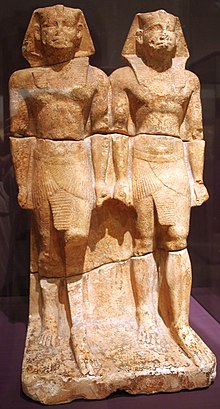 Double statue portraying Nyuserre as both a young man and an old man, Museum of Egyptian Art in Munich
Pharaoh Reign 24 to 35 years in the late 25th century BCE[note 1][note 2] Predecessor Shepseskare (most likely) or Neferefre Successor Menkauhor Kaiu Consort Reptynub, at least another queen whose name is lost, possibly two Children Khamerernebty ♀, Reputnebty ♀, Sheretnebty ♀,
Khentykauhor ♂, Okpo♂
Unlikely: Menkauhor Kaiu ♂ Father Neferirkare Kakai Mother Khentkaus II Burial Pyramid of Nyuserre Ini Monuments Built ex-nihilo:
Pyramid of Nyuserre Ini
Pyramid Lepsius XXIV
Lepsius XXV
Sun temple Shesepibre
Completed:
Pyramid of Neferirkare Kakai
Pyramid of Neferefre
Pyramid complex of Khentkaus II
Sun temple of Userkaf
Renovated:
Mortuary complex of Menkaure
Uncertain:
Temple of Satet Dynasty Fifth Dynasty
Nyuserre Ini (also Niuserre Ini or Neuserre Ini; in Greek known as Rathurês, Ῥαθούρης) was an Ancient Egyptian pharaoh, the sixth ruler of the Fifth Dynasty during the Old Kingdom period. He is credited with a reign of 24 to 35 years depending on the scholar, and likely lived in the second half of the 25th century BCE. Nyuserre was the younger son of Neferirkare Kakai and queen Khentkaus II, and the brother of the short-lived king Neferefre. He may have succeeded his brother directly, as indicated by much later historical sources. Alternatively, Shepseskare may have reigned between the two as advocated by Miroslav Verner, albeit only for a few weeks or months at the most. The relation of Shepseskare with Neferefre and Nyuserre remains highly uncertain. Nyuserre was in turn succeeded by Menkauhor Kaiu, who could have been his nephew and a son of Neferefre.
Nyuserre was the most prolific builder of his dynasty, having built three pyramids for himself and his queens and completed a further three for his father, mother and brother, all in the necropolis of Abusir. He built the largest surviving temple to the sun god Ra constructed during the Old Kingdom, named Shesepibre or "Joy of the heart of Ra". He also completed the Nekhenre, the Sun temple of Userkaf in Abu Gorab, and the valley temple of Menkaure in Giza. In doing so, he was the first king since Shepseskaf, last ruler of the Fourth Dynasty, to pay attention to the Giza necropolis, a move which may have been an attempt to legitimise his rule following the troubled times surrounding the unexpected death of his brother Neferefre.
There is little evidence for military action during Nyuserre's reign; the Egyptian state continued to maintain trade relations with Byblos on the Levantine coast and to send mining and quarrying expeditions to Sinai and Lower Nubia. Nyuserre's reign saw the growth of the administration, and the effective birth of the nomarchs, provincial governors who, for the first time, were sent to live in the provinces they administered rather than at the pharaoh's court.
As with other Old Kingdom pharaohs, Nyuserre benefited from a funerary cult established at his death. In Nyuserre's case, this official state-sponsored cult existed for centuries, surviving the chaotic First Intermediate Period and lasting until the Twelfth Dynasty of the Middle Kingdom. In parallel, a spontaneous popular cult appeared, with people venerating Nyuserre under his birth name "Iny". In this cult, Nyuserre played a role similar to that of a saint, being invoked as an intercessor between the believer and the gods. It left little archaeological evidence and seems to have continued until the New Kingdom, nearly 1000 years after his death.

| Nyuserre Ini | |
|---|---|
| Niuserre Ini, Neuserre Ini, Nyuserra, Newoserre Any, Rathoris | |
 Double statue portraying Nyuserre as both a young man and an old man, Museum of Egyptian Art in Munich | |
| Pharaoh | |
| Reign | 24 to 35 years in the late 25th century BCE[note 1][note 2] |
| Predecessor | Shepseskare (most likely) or Neferefre |
| Successor | Menkauhor Kaiu |
| Consort | Reptynub, at least another queen whose name is lost, possibly two |
| Children | Khamerernebty ♀, Reputnebty ♀, Sheretnebty ♀, Khentykauhor ♂, Okpo♂ Unlikely: Menkauhor Kaiu ♂ |
| Father | Neferirkare Kakai |
| Mother | Khentkaus II |
| Burial | Pyramid of Nyuserre Ini |
| Monuments | Built ex-nihilo: Pyramid of Nyuserre Ini Pyramid Lepsius XXIV Lepsius XXV Sun temple Shesepibre Completed: Pyramid of Neferirkare Kakai Pyramid of Neferefre Pyramid complex of Khentkaus II Sun temple of Userkaf Renovated: Mortuary complex of Menkaure Uncertain: Temple of Satet |
| Dynasty | Fifth Dynasty |
Nyuserre Ini (also Niuserre Ini or Neuserre Ini; in Greek known as Rathurês, Ῥαθούρης) was an Ancient Egyptian pharaoh, the sixth ruler of the Fifth Dynasty during the Old Kingdom period. He is credited with a reign of 24 to 35 years depending on the scholar, and likely lived in the second half of the 25th century BCE. Nyuserre was the younger son of Neferirkare Kakai and queen Khentkaus II, and the brother of the short-lived king Neferefre. He may have succeeded his brother directly, as indicated by much later historical sources. Alternatively, Shepseskare may have reigned between the two as advocated by Miroslav Verner, albeit only for a few weeks or months at the most. The relation of Shepseskare with Neferefre and Nyuserre remains highly uncertain. Nyuserre was in turn succeeded by Menkauhor Kaiu, who could have been his nephew and a son of Neferefre.
Nyuserre was the most prolific builder of his dynasty, having built three pyramids for himself and his queens and completed a further three for his father, mother and brother, all in the necropolis of Abusir. He built the largest surviving temple to the sun god Ra constructed during the Old Kingdom, named Shesepibre or "Joy of the heart of Ra". He also completed the Nekhenre, the Sun temple of Userkaf in Abu Gorab, and the valley temple of Menkaure in Giza. In doing so, he was the first king since Shepseskaf, last ruler of the Fourth Dynasty, to pay attention to the Giza necropolis, a move which may have been an attempt to legitimise his rule following the troubled times surrounding the unexpected death of his brother Neferefre.
There is little evidence for military action during Nyuserre's reign; the Egyptian state continued to maintain trade relations with Byblos on the Levantine coast and to send mining and quarrying expeditions to Sinai and Lower Nubia. Nyuserre's reign saw the growth of the administration, and the effective birth of the nomarchs, provincial governors who, for the first time, were sent to live in the provinces they administered rather than at the pharaoh's court.
As with other Old Kingdom pharaohs, Nyuserre benefited from a funerary cult established at his death. In Nyuserre's case, this official state-sponsored cult existed for centuries, surviving the chaotic First Intermediate Period and lasting until the Twelfth Dynasty of the Middle Kingdom. In parallel, a spontaneous popular cult appeared, with people venerating Nyuserre under his birth name "Iny". In this cult, Nyuserre played a role similar to that of a saint, being invoked as an intercessor between the believer and the gods. It left little archaeological evidence and seems to have continued until the New Kingdom, nearly 1000 years after his death.
Sources
Sixth Dynasty[edit]
The Sixth Dynasty ruled from 2345 to 2181 BC.
| Image | Throne name | Personal name | Comments | Dates |
|---|---|---|---|---|
 | — | Teti | According to Manetho, he was murdered. | 2345–2333 BC |
 | Userkare | Reigned one to five years, may have usurped the throne at the expense of Teti | 2333–2332 BC | |
 | Meryre | Pepi I | Faced conspiracies and political troubles yet became the most prolific builder of his dynasty | 2332–2283 BC |
 | Merenre | Nemtyemsaf I | Reformed the administration of Upper Egypt by decentralization, received the submission of Lower Nubia | 2283–2278 BC |
 | Neferkare | Pepi II | Possibly the longest-reigning monarch in human history, with 94 years on the throne. Alternatively, may have reigned only 64 years. | 2278–2183 BC |
| — | Neferka | Reigned during Pepi II; was possibly his son or co-ruler. Possibly writing mistake for "Neferkare" | 2200–2199 BC | |
 | Merenre | Nemtyemsaf II[68] | Short lived pharaoh, possibly an aged son of Pepi II. | 1 year and 1 month c. 2183 BC |
 | Netjerkare I | Neitiqerty Siptah (Nitocris) | This male king gave rise to the legendary queen Nitocris of Herodotus and Manetho.[69] Sometimes classified as the first king of the combined 7th/8th Dynasties. | Short reign: c. 2182–2179 BC |
First Intermediate Period
Pyramid of Khendjer
| Pyramid of Khendjer[1] | |
|---|---|
Reconstruction of the pyramid complex of Khendjer. | |
| Khendjer, 13th Dynasty | |
| Coordinates | 29°49′56″N 31°13′26″E |
| Constructed | c. 1760 BC |
| Type | True pyramid (now ruined) |
| Material | Mudbrick core with limestone casing |
| Height | 37.35 m (122.5 ft), now 1 m (3.3 ft) |
| Base | 52.5 m (172 ft) |
| Volume | 34,315 m3 (44,882 cu yd) |
| Slope | 55° |

The pyramid of Khendjer was a pyramid built for the burial of the 13th dynasty pharaoh Khendjer, who ruled Egypt c. 1760 BC during the Second Intermediate Period.[2] The pyramid, which is part of larger complex comprising a mortuary temple, a chapel, two enclosure walls and a subsidiary pyramid, originally stood around 37 m (121 ft) high and is now completely ruined.[1] The pyramidion was discovered during excavations under the direction of Gustave Jéquier in 1929, indicating that the pyramid was finished during Khendjer's lifetime.[3] It is the only pyramid known to have been completed during the 13th Dynasty.
The first investigations of the pyramid of Khendjer were undertaken in the mid 19th century by Karl Richard Lepsius, who included the pyramid in his list under the number XLIV. The pyramid was excavated by Gustave Jéquier from 1929 until 1931 with the excavation report published two years later in 1933.[3]
The pyramid complex of Khendjer is located between the pyramid of Pepi II and the pyramid of Senusret III in South Saqqara. The main pyramid currently lies in ruins, due in part to the damaging excavations by G. Jéquier and now rises only about one meter above the desert sand.[1]
The pyramid complex comprises the main pyramid enclosed by two walls. The outer one, made of mudbrick, contained in the north-east corner a small subsidiary pyramid, the only one known dating to the 13th dynasty. The inner enclosure wall was made of limestone and patterned with niches and panels.[1] This replaced an earlier mudbrick wavy-wall, which led Rainer Stadelmann to suggest that the wavy-wall was constructed as a provisional and abbreviated substitute to the more time consuming but preferred niched-wall. At the south-east corner of the outer wall is a blocked unfinished stairway, which could be part of earlier plans for the pyramid substructure or part of an unfinished south tomb, meant for the Ka of the deceased king.[1]

A small chapel was built immediately adjacent to the north side of the main pyramid, inside the inner enclosure wall. The chapel was raised on a platform and could be reached by two stairways. The north wall of the chapel housed a yellow quartzite false door. The location of this door was unusual as it should have stood on the wall closest to the pyramid, i.e. the south wall rather than the north one. The few surviving fragments of relief from the chapel show standard scenes with offering bearers.[1]
On the eastern side of the pyramid lay a mortuary temple which spread across both enclosure walls. This allowed for the outer section of the temple to be placed outside the inner wall, with the inner sanctuary on the inside of the inner wall. Very little remains of the temple, except for pieces of reliefs and columns and parts of its pavement.

The pyramid originally stood at 70 royal cubits in height, which is about 37 metres (121 ft).[4] The pyramid was constructed with a mudbrick core and a limestone outer casing with its backing stones. These and the limestone casing were both quarried by stone robbers, which left the core unprotected. The core fared very badly with time and the pyramid now stands only one meter (3.3 feet) tall due to its disintegration.
A fragmented black granite pyramidion was discovered on the east side of the complex and has been restored by G. Jéquier. It is now on display at the Egyptian Museum, Cairo. The pyramidion is decorated by reliefs showing Khendjer making offerings and is inscribed with the prenomen "Userkare" (Strong is the ka of Ra), which is thus known to be a throne name of Khendjer.
The entrance to the substructures is located at the base of the southern end of the pyramid west side. A stairway with 13 steps leads to a chamber housing a large granite portcullis similar to those encountered in the Mazghuna pyramids, also dated from the Middle Kingdom. The portcullis was originally destined to block the way to the burial chamber but was never put into place across the passage. Beyond the portcullis chamber, a further stairway with 39 steps continued down to a closed double-leaf wooden door. Beyond the door is a second portcullis chamber, which was also left open.[1] In turn this leads to a small antechamber and from there on to a further corridor whose access was concealed beneath the paving of the antechamber floor. This corridor leads to the burial chamber.

Khendjer's second portcullis chamber, antechamber and corridor were constructed in the corner of a large trench dug in the ground. The burial chamber, which is made of a colossal monolithic quartzite block, was placed in the trench before the pyramid construction started, in a manner similar to the burial chamber of Amenemhet III at Hawara. The weight of the quartzite block was estimated at 150 tons by G. Jéquier.[3] The block was carved into two compartments destined to receive the king's coffin, canopic chest and funerary goods. Two large quartzite beams weighing 60 tons formed its roof.[4] Once the block and its roof had been put into position, the workers built a gabled roof of limestone beams and a brick vault above it to relieve the weight of the pyramid.[1] The mechanism for closing the vault consisted of sand-filled shafts on which rested the props of the northern ceiling slab. This would be lowered on the vault on draining the sand.[5] After draining all the sand, the workmen escaped through the corridor which they filled with masonry and paved over its opening in the antechamber.

At the north eastern corner of Khendjer's pyramid complex is a small subsidiary pyramid, which is thought to have been prepared for the burials of two of Khendjer's queens. G. Jéquier also found shaft tombs nearby, which may have been prepared for other royal family members. The entrance to the substructures of this pyramid lie at the base of its eastern base. A small stairway leads to two portcullis chambers similar to those found in the main pyramid. Here too the portcullises were left open. Beyond is an antechamber branching to the north and south to two burial chambers lined with masonry and both housing a large quartzite coffer. The lids of the coffers were found propped on blocks as they should be before any burial. The two coffers were thus most probably never lowered into place and put into use.[1]
Some unexpected turn of events probably prevented their use, although there is nothing directly suggesting that the king wasn't interred as planned in the main pyramid.[6][7] However, in his 1997 study of the Second Intermediate Period, egyptologist Kim Ryholt concludes that Khendjer's successor, Imyremeshaw, usurped the throne.[2]
.png)


Comments
Post a Comment