Ihyis a young god in Egypt usually portrayed with thesistrum. This is in allusion to his motherHathorwho was associated with the instrument. Ihy's symbols are the sistrum and a necklace. The name Ihy depicts the joy of playing the hand instrument by Hathor, or "calf." The Egyptians themselves associated the name with the noisemaker.[1]
Other goddesses including Isis, Sekhmet, and Neith are also sometimes seen as his mothers in different legends. War deity Horus is Ihy's father, but sometimes solar deity Ra is also seen as his father.[1] Ihy was depicted as a naked child, with curly hair, wearing a necklace and holding a sistrum or as a nude child with his finger in his mouth. He was worshipped along with Horus and Hathor as a trio at Dendera, Ihy's main cult site, constructed early in the 4th dynasty.[2]
Emperor Augustus prepared a second "birthing house" in the temple of Ihy's mother, with pictures of Ihy's birth and celebrations painted on the wall. Ihy is shown as the god of bread, beer, coffins, and the Book of the dead.[1] There were mystery plays in 13 acts on fertility in these temples.[3][4]
Then comes the
Chalcolithic aka CATHOLIC
From Wikipedia, the free encyclopedia
The Chalcolithic (also called the Copper Age and Eneolithic)[a] was an archaeological period characterized by the increasing use of smelted copper. It followed the Neolithic and preceded the Bronze Age. It occurred at different periods in different areas, but was absent in some parts of the world, such as Russia, where there was no well-defined Copper Age between the Stone and Bronze ages.[1] Stone tools were still predominantly used during this period.[2]
A study in the journal Antiquity from 2013 reporting the discovery of a tin bronze foil from the Pločnik archaeological site dated to c. 4,650 BC, as well as 14 other artefacts from Bulgaria and Serbia dated to before 4,000 BC, showed that early tin bronze was more common than previously thought and developed independently in Europe 1,500 years before the first tin bronze alloys in the Near East.[5] In Britain, the Chalcolithic is a short period between about 2,500 and 2,200 BC, characterized by the first appearance of objects of copper and gold, a new ceramic culture and the immigration of Beaker culture people, heralding the end of the local late Neolithic.[1]
Hathor (Ancient Egyptian: ḥwt-ḥr, lit. 'House of Horus', Ancient Greek: ἉθώρHathōr, Coptic: ϩⲁⲑⲱⲣ, Meroitic: 𐦠𐦴𐦫𐦢 Atari) was a major goddess in ancient Egyptian religion who played a wide variety of roles. As a sky deity, she was the mother or consort of the sky god Horus and the sun godRa, both of whom were connected with kingship, and thus she was the symbolic mother of their earthly representatives, the pharaohs. She was one of several goddesses who acted as the Eye of Ra, Ra's feminine counterpart, and in this form, she had a vengeful aspect that protected him from his enemies. Her beneficent side represented music, dance, joy, love, sexuality, and maternal care, and she acted as the consort of several male deities and the mother of their sons. These two aspects of the goddess exemplified the Egyptian conception of femininity. Hathor crossed boundaries between worlds, helping deceased souls in the transition to the afterlife.
Hathor was often depicted as a cow, symbolizing her maternal and celestial aspect, although her most common form was a woman wearing a headdress of cow horns and a sun disk. She could also be represented as a lioness, a cobra, or a sycamore tree.
Cattle goddesses similar to Hathor were portrayed in Egyptian art in the fourth millennium BC, but she may not have appeared until the Old Kingdom (c. 2686–2181 BC). With the patronage of Old Kingdom rulers, she became one of Egypt's most important deities. More temples were dedicated to her than to any other goddess; her most prominent temple was Dendera in Upper Egypt. She was also worshipped in the temples of her male consorts. The Egyptians connected her with foreign lands, such as Nubia and Canaan, and their valuable goods, such as incense and semiprecious stones, and some of the peoples in those lands adopted her worship. In Egypt, she was one of the deities commonly invoked in private prayers and votive offerings, particularly by women desiring children.
During the New Kingdom (c. 1550–1070 BC), goddesses such as Mut and Isis encroached on Hathor's position in royal ideology, but she remained one of the most widely worshipped deities. After the end of the New Kingdom, Hathor was increasingly overshadowed by Isis, but she continued to be venerated until the extinction of ancient Egyptian religion in the early centuries AD.
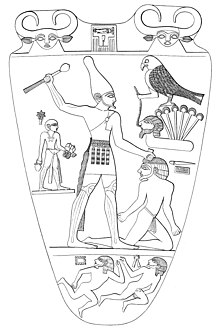
Drawing of the Narmer Palette, c.31st century BC. The face of a woman with the horns and ears of a cow, representing Hathor or Bat, appears twice at the top of the palette and in a row below the belt of the king.
Images of cattle appear frequently in the artwork of Predynastic Egypt (before c. 3100 BC), as do images of women with upraised, curved arms, reminiscent of the shape of bovine horns. Both types of imagery may represent goddesses connected with cattle.[2] Cows are venerated in many cultures, including ancient Egypt, as symbols of motherhood and nourishment, because they care for their calves and provide humans with milk. The Gerzeh Palette, a stone palette from the Naqada II period of prehistory (c. 3500–3200 BC), shows the silhouette of a cow's head with inward-curving horns surrounded by stars. The palette suggests that this cow was also linked with the sky, as were several goddesses from later times who were represented in this form: Hathor, Mehet-Weret, and Nut.[3]
Despite these earlier precedents, Hathor is not unambiguously mentioned or depicted until the Fourth Dynasty (c. 2613–2494 BC) of the Old Kingdom,[4] although several artifacts that refer to her may date to the Early Dynastic Period (c. 3100–2686 BC).[5] When Hathor does clearly appear, her horns curve outward, rather than inward like those in Predynastic art.[6]
A bovine deity with inward-curving horns appears on the Narmer Palette from near the start of Egyptian history, both atop the palette and on the belt or apron of the king, Narmer. The Egyptologist Henry George Fischer suggested this deity may be Bat, a goddess who was later depicted with a woman's face and inward-curling horns, seemingly reflecting the curve of the cow horns.[6] The Egyptologist Lana Troy, however, identifies a passage in the Pyramid Texts from the late Old Kingdom that connects Hathor with the "apron" of the king, reminiscent of the goddess on Narmer's garments, and suggests the goddess on the Narmer Palette is Hathor rather than Bat.[4][7]
In the Fourth Dynasty, Hathor rose rapidly to prominence.[8] She supplanted an early crocodile god who was worshipped at Dendera in Upper Egypt to become Dendera's patron deity, and she increasingly absorbed the cult of Bat in the neighboring region of Hu, so that in the Middle Kingdom (c. 2055–1650 BC) the two deities fused into one.[9] The theology surrounding the pharaoh in the Old Kingdom, unlike that of earlier times, focused heavily on the sun god Ra as king of the gods and father and patron of the earthly king. Hathor ascended with Ra and became his mythological wife, and thus divine mother of the pharaoh.[8]
Hathor was given the epithets "mistress of the sky" and "mistress of the stars", and was said to dwell in the sky with Ra and other sun deities. Egyptians thought of the sky as a body of water through which the sun god sailed, and they connected it with the waters from which, according to their creation myths, the sun emerged at the beginning of time. This cosmic mother goddess was often represented as a cow. Hathor and Mehet-Weret were both thought of as the cow who birthed the sun god and placed him between her horns. Like Nut, Hathor was said to give birth to the sun god each dawn.[14]
Hathor's Egyptian name was ḥwt-ḥrw[15] or ḥwt-ḥr.[16] It is typically translated "house of Horus" but can also be rendered as "my house is the sky".[17] The falcon god Horus represented, among other things, the sun and sky. The "house" referred to may be the sky in which Horus lives, or the goddess's womb from which he, as a sun god, is born each day.[18]
In Egyptian mythology, Kebechet (spelt in hieroglyphs as Qeb-Hwt, and also transliterated as Khebhut, Kebehut, Qébéhout, Kabehchet and Kebehwet) is a goddess, a deification of embalming liquid. Her name means cooling water.[2]
Kebechet was thought to give water to the spirits of the dead while they waited for the mummification process to be complete. She was probably related to mummification where she would fortify the body against corruption, so it would stay fresh for reanimation by the deceased's ka.
The word pharaoh ultimately derives from the Egyptian compound pr ꜥꜣ, */ˌpaɾuwˈʕaʀ/ "great house", written with the two biliteral hieroglyphspr "house" and ꜥꜣ "column", here meaning "great" or "high". It was the title of the royal palace and was used only in larger phrases such as smr pr-ꜥꜣ "Courtier of the High House", with specific reference to the buildings of the court or palace.[13] From the Twelfth Dynasty onward, the word appears in a wish formula "Great House, May it Live, Prosper, and be in Health", but again only with reference to the royal palace and not a person.
In the early dynasties, ancient Egyptian kings had as many as three titles: the Horus, the Sedge and Bee (nswt-bjtj), and the Two Ladies or Nebty (nbtj) name.[6] The Golden Horus and the nomen and prenomen titles were added later.[7]
In Egyptian society, religion was central to everyday life. One of the roles of the king was as an intermediary between the deities and the people. The king thus was deputised for the deities in a role that was both as civil and religious administrator. The king owned all of the land in Egypt, enacted laws, collected taxes, and served as commander-in-chief of the military.[8] Religiously, the king officiated over religious ceremonies and chose the sites of new temples. The king was responsible for maintaining Maat (mꜣꜥt), or cosmic order, balance, and justice, and part of this included going to war when necessary to defend the country or attacking others when it was believed that this would contribute to Maat, such as to obtain resources.[9]
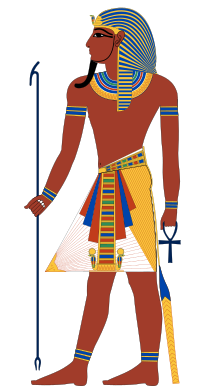
During the early days prior to the unification of Upper and Lower Egypt, the Deshret or the "Red Crown", was a representation of the kingdom of Lower Egypt,[10] while the Hedjet, the "White Crown", was worn by the kings of Upper Egypt.[11] After the unification of both kingdoms, the Pschent, the combination of both the red and white crowns became the official crown of the pharaoh.[12] With time new headdresses were introduced during different dynasties such as the Khat, Nemes, Atef, Hemhem crown, and Khepresh. At times, a combination of these headdresses or crowns worn together was depicted.
Etymology
The word pharaoh ultimately derives from the Egyptian compound pr ꜥꜣ, */ˌpaɾuwˈʕaʀ/ "great house", written with the two biliteral hieroglyphspr "house" and ꜥꜣ "column", here meaning "great" or "high". It was the title of the royal palace and was used only in larger phrases such as smr pr-ꜥꜣ "Courtier of the High House", with specific reference to the buildings of the court or palace.[13] From the Twelfth Dynasty onward, the word appears in a wish formula "Great House, May it Live, Prosper, and be in Health", but again only with reference to the royal palace and not a person.
Sometime during the era of the New Kingdom, pharaoh became the form of address for a person who was king. The earliest confirmed instance where pr ꜥꜣ is used specifically to address the ruler is in a letter to the eighteenth dynasty king, Akhenaten (reigned c. 1353–1336 BCE), that is addressed to "Great House, L, W, H, the Lord".[14][15]
Clay minerals form in the presence of water[1] and have been important to life, and many theories of abiogenesis involve them. They are important constituents of soils, and have been useful to humans since ancient times in agriculture and manufacturing.
Like all phyllosilicates, clay minerals are characterised by two-dimensional sheets of corner-sharing SiO4 tetrahedra or AlO4 octahedra. The sheet units have the chemical composition (Al, Si)3O4. Each silica tetrahedron shares three of its vertex oxygen ions with other tetrahedra, forming a hexagonal array in two dimensions. The fourth oxygen ion is not shared with another tetrahedron and all of the tetrahedra "point" in the same direction; i.e. all of the unshared oxygen ions are on the same side of the sheet. These unshared oxygen ions are called apical oxygen ions.[20]
Clay minerals form in the presence of water[1] and have been important to life, and many theories of abiogenesis involve them. They are important constituents of soils, and have been useful to humans since ancient times in agriculture and manufacturing.
Hexagonal sheets of the clay mineral kaolinite (SEM image, 1,340× magnification)
Clay is a very fine-grained geologic material that develops plasticity when wet, but becomes hard, brittle and non–plastic upon drying or firing.[2][3][4] It is a very common material,[5] and is the oldest known ceramic. Prehistoric humans discovered the useful properties of clay and used it for making pottery.[6] The chemistry of clay, including its capacity to retain nutrient cations such as potassium and ammonium, is important to soil fertility.[7]
Because the individual particles in clay are less than 4 micrometers (0.00016 in) in size, they cannot be characterized by ordinary optical or physical methods. The crystallographic structure of clay minerals became better understood in the 1930s with advancements in the x-ray diffraction (XRD) technique indispensable to deciphering their crystal lattice.[8] Clay particles were found to be predominantly sheet silicate (phyllosilicate) minerals, now grouped together as clay minerals. Their structure is based on flat hexagonal sheets similar to those of the mica group of minerals.[9] Standardization in terminology arose during this period as well,[8] with special attention given to similar words that resulted in confusion, such as sheet and plane.[8]
View of tetrahedral sheet structure of a clay mineral. Apical oxygen ions are tinted pink.
Like all phyllosilicates, clay minerals are characterised by two-dimensional sheets of corner-sharing SiO4 tetrahedra or AlO4 octahedra. The sheet units have the chemical composition (Al, Si)3O4. Each silica tetrahedron shares three of its vertex oxygen ions with other tetrahedra, forming a hexagonal array in two dimensions. The fourth oxygen ion is not shared with another tetrahedron and all of the tetrahedra "point" in the same direction; i.e. all of the unshared oxygen ions are on the same side of the sheet. These unshared oxygen ions are called apical oxygen ions.[20]
In clays, the tetrahedral sheets are always bonded to octahedral sheets formed from small cations, such as aluminum or magnesium, and coordinated by six oxygen atoms. The unshared vertex from the tetrahedral sheet also forms part of one side of the octahedral sheet, but an additional oxygen atom is located above the gap in the tetrahedral sheet at the center of the six tetrahedra. This oxygen atom is bonded to a hydrogen atom forming an OH group in the clay structure. Clays can be categorized depending on the way that tetrahedral and octahedral sheets are packaged into layers. If there is only one tetrahedral and one octahedral group in each layer the clay is known as a 1:1 clay. The alternative, known as a 2:1 clay, has two tetrahedral sheets with the unshared vertex of each sheet pointing towards each other and forming each side of the octahedral sheet.[20]
Bonding between the tetrahedral and octahedral sheets requires that the tetrahedral sheet becomes corrugated or twisted, causing ditrigonal distortion to the hexagonal array, and the octahedral sheet is flattened. This minimizes the overall bond-valence distortions of the crystallite.[20]
Depending on the composition of the tetrahedral and octahedral sheets, the layer will have no charge or will have a net negative charge. If the layers are charged this charge is balanced by interlayer cations such as Na+ or K+ or by a lone octahedral sheet. The interlayer may also contain water. The crystal structure is formed from a stack of layers interspaced with the interlayers.[20]
ΙΩΑΝΝΗΣ 1119 In The bible of Babble The number 1119 is important as being that given to the name of the "Baptist" mystically communicated by the "Angel" so you are told to Zacharias The ''name'' of "the baptist" among the Hebrews was not a common one and has been given the "meaning" ‘Jah is Gracious’ We are not as in the case of the name ΙΗΣΟΥΣ bound to regard the particular mode of spelling as invariable but as the mnemonic that it is ΙΩΑΝΝΗΣ = 1119 as found in the book of babble plainly has a mystical 'teaching' in connection with the "Baptism of Jesus" containing as it does the threefold potency of the number 373 represented by the mnemonic ΛΟΓΟΣ - reason 1119 = 3 × 373 ΛΟΓΟΣ and herein we may trace a foreshadowing of the triple manifestation of "God's Essence" at the "Baptism" And the name ΙΩΑΝΝΗΣ is linked to that...
Theory [ edit ] The underlying premise of spectroscopy is that light is made of different wavelengths and that each wavelength corresponds to a different frequency. The importance of spectroscopy is centered around the fact that every element in the periodic table has a unique light spectrum described by the frequencies of light it emits or absorbs consistently appearing in the same part of the electromagnetic spectrum when that light is diffracted. This opened up an entire field of study with anything that contains atoms. Spectroscopy is the key to understanding the atomic properties of all matter. As such spectroscopy opened up many new sub-fields of science yet undiscovered. The idea that each atomic element has its unique spectral signature enabled spectroscopy to be used in a broad number of fields each with a specific goal achieved by different spectroscopic procedures. The National Institute of Standards and Technology maintains a public Atomic Spec...
Door #1 Djed 21 languages Article Talk Read Edit View history Tools From Wikipedia, the free encyclopedia For other uses, see Djed (disambiguation) . The djed , an ancient Egyptian symbol meaning 'stability', is the symbolic backbone of the god Osiris . The djed , also djt ( Ancient Egyptian : ḏd 𓊽 , Coptic ϫⲱⲧ jōt "pillar", anglicized /dʒɛd/) [1] is one of the more ancient and commonly found symbols in ancient Egyptian religion . It is a pillar -like symbol in Egyptian hieroglyphs representing stability. It is associated with the creator god Ptah and Osiris , the Egyptian god of the afterlife, the underworld, and the dead. It is commonly understood to represent his spine . Myth [ edit ] In the Osiris myth , Osiris was killed by Set by being tricked into a coffin made to fit Osiris exactly. Set then had the coffin w...
.png)

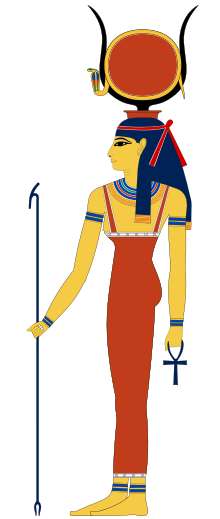 Composite image of Hathor's most common iconography, based partly on images from the tomb of Nefertari




 The GAS can used to Capture Extracted Gas by Shaking it out of water using input from


 From Wikipedia, the free encyclopediaThis article is about the title in general. For a list of pharaohs, see List of pharaohs. For other uses, see Pharaoh (disambiguation).





.png)


Comments
Post a Comment