Poppy whats in a name

Fat Glatiators makes sense the more the picture of life a few thousand years ago comes into focus the more it is the case that for the last few thousand years not a lot has changed when everything is put in to the same bucket the fruit of the tree comes to the front of the list every time one needs to write an idea down and when pen it put to paper suddenly the world changes just as it does in dreams...
 Drugs have always been used in all societies for medicinal reasons for non medicinal reasons all drugs used and sold by the government are synthetic correlates of substances found in nature in plants or in other animals some of these synthetic substances are abundantly produced in the hominid by the hominid where the medical system of said hominid is operating at a rate of function closer to homeostasis than a system of said hominid when operating at a rate of function not so close to homeo static magnet type of stasis where the positive and negative ends are always happy to be a round the same strength while being entirely opposite forces controlled only by the other end of the metal edge or surface or twist or core or switchable switch which switches switchable magnets on and off and then there is the good ole redox which is fundamentally the soup that we swim so poorly inside of no wonder
moby dick ate the captian it was an event that could only have been inspired by Al Pacino as Doctor K the non believer in starvation and extended torture at the expense of the more often than not more than willing up to a point client in the big business of inching half the inches left to the end or the beginning a journey beyond the well known end of which no report has returned in a fungible manner observable by any with no claimed special senses abilities knowledge not commonly shared by the m dogs that dog us as they dog they zeZus


Traditional interpretations[edit]
Immortality[edit]
Christian exegetes of Genesis 2:17[12] ("for in the day that you eat of it you shall die") have applied the day-year principle to explain how Adam died within a day. Psalms 90:4,[13] 2 Peter 3:8[14] and Jubilees 4:29–31[15] explain that, to God, one day is equivalent to a thousand years and thus Adam died within that same "day".[16] The Greek Septuagint, on the other hand, has "day" translated into the Greek word for a twenty-four-hour period (ἡμέρα, hēméra).
According to the Genesis narrative, during the antediluvian age, human longevity approached a millennium, such as the case of Adam who lived 930 years. Thus, to "die" has been interpreted as to become mortal.[17] However, the grammar does not support this reading, nor does the narrative: Adam and Eve are expelled from the Garden lest they eat of the second tree, the tree of life, and gain immortality.[18][19]
Original sin[edit]

The Catechism of the Catholic Church says: "The account of the fall in Genesis 3 uses figurative language, but affirms [...] that the whole of human history is marked by the original fault freely committed by our first parents."[20] St Bede and others, especially Thomas Aquinas, said that the fall of Adam and Eve brought "four wounds" to human nature.[21] They are original sin (lack of sanctifying grace and original justice), concupiscence (the soul's passions are no longer ordered perfectly to the soul's intellect), physical frailty and death, and darkened intellect and ignorance. These negated or diminished the gifts of God to Adam and Eve of original justice or sanctifying grace, integrity, immortality and infused knowledge. This first sin was "transmitted" by Adam and Eve to all of their descendants as original sin, causing humans to be "subject to ignorance, suffering and the dominion of death, and inclined to sin."[22]
In the light of modern scripture scholarship, the future Pope Benedict XVI stated in 1986 that: "In the Genesis story [...] sin is not spoken of in general as an abstract possibility but as a deed, as the sin of a particular person, Adam, who stands at the origin of humankind and with whom the history of sin begins. The account tells us that sin begets sin, and that therefore all the sins of history are interlinked. Theology refers to this state of affairs by the certainly misleading and imprecise term 'original sin.'"[23] Although the state of corruption, inherited by humans after the primaeval event of original sin, is clearly called guilt or sin, it is understood as a sin acquired by the unity of all humans in Adam rather than a personal responsibility of humanity. In the Catechism of the Catholic Church, even children partake in the effects of the sin of Adam, but not in the responsibility of original sin, as sin is always a personal act.[24] Baptism is considered to erase original sin, though the effects on human nature remain, and for this reason, the Catholic Church baptizes even infants who have not committed any personal sin.
Eastern Orthodox Christianity rejects the idea that the guilt of original sin is passed down through generations. It bases its teaching in part on Ezekiel 18:20[25] that says a son is not guilty of the sins of his father. The Church teaches that, in addition to their conscience and tendency to do good, men and women are born with a tendency to sin due to the fallen condition of the world. It follows Maximus the Confessor and others in characterising the change in human nature as the introduction of a "deliberative will" (θέλημα γνωμικόν) in opposition to the "natural will" (θέλημα φυσικόν) created by God which tends toward the good. Thus, according to Paul the Apostle in his epistle to the Romans, non-Christians can still act according to their conscience.
Eastern Orthodoxy believes that, while everyone bears the consequences of the first sin (that is, death), only Adam and Eve are guilty of that sin.[26] Adam's sin is not comprehended only as disobedience to God's commandment, but as a change in man's hierarchy of values from theocentricism to anthropocentrism, driven by the object of his lust, outside of God, in this case the tree which was seen to be "good for food", and something "to be desired" (see also theosis, seeking union with God).[27]
Subordination[edit]
Traditionally, women have received the major blame for the Fall of humanity. The subordination exegesis is that the natural consequences of sin entering the human race, was prophesied by God when the phrase was made: the husband "will rule over you". This interpretation is reinforced by comments in the First Epistle to Timothy, where the author gives a rationale for directing that a woman (NIV: possibly "wife"):
Therefore, some interpretations of these passages from Genesis 3 and 1 Timothy 2 have developed a view that women are considered as bearers of Eve's guilt and that the woman's conduct in the fall is the primary reason for her universal, timeless, subordinate relationship to the man.[29]: 21
Alternatively, Richard and Catherine Clark Kroeger argue that "there is a serious theological contradiction in telling a woman that when she comes to faith in Christ, her personal sins are forgiven but she must continue to be punished for the sin of Eve." They maintain that judgmental comments against women in reference to Eve are a "dangerous interpretation, in terms both of biblical theology and of the call to Christian commitment". They reason that "if the Apostle Paul was forgiven for what he did ignorantly in unbelief", including persecuting and murdering Christians, "and thereafter was given a ministry, why would the same forgiveness and ministry be denied women" (for the sins of their foremother, Eve). Addressing that, the Kroegers conclude that Paul was referring to the promise of Genesis 3:15[30] that through the defeat of Satan on the cross of Jesus Christ, the woman's child (Jesus) would crush the serpent's head, but the serpent would only bruise the heel of her child.[29]: 144 Moreover, many scholars[who?] suggest that the concept of inherited guilt in Christianity is a controversial subject at best, and must be treated with care.[citation needed]
Agricultural revolution[edit]
 | This section may present fringe theories, without giving appropriate weight to the mainstream view, and explaining the responses to the fringe theories. (April 2022) |
Some of the Genesis 3 narrative's symbolism may correlate to the experience of the agricultural revolution.[citation needed] The serpent of the Genesis narrative may represent seasonal changes and renewal, as with the symbolism of Sumerian, Egyptian, and other creation myths.[31] In Mesoamerican creation myths, Quetzalcoatl, a feathered serpent agricultural deity, is associated with learning as well as renewal.[32] The leading role of Eve in the Genesis narrative may be attributed to the interest of neolithic women in shifting away from gatherer life in favor of raising crops. Women also may have taken the role of organizers in early farming settlements, thus effectively leading the shift to agrarian society.[citation needed] Though these settlements may have been relatively egalitarian compared to more modern societies, the Genesis narrative may be interpreted as mourning the hunter-gatherer life as a paradise lost.[citation needed]
Other interpretations[edit]
Gnosticism[edit]

Gnosticism originated in the late 1st century CE in non-rabbinical Jewish and early Christian sects.[33] In the formation of Christianity, various sectarian groups, labeled "gnostics" by their opponents, emphasised spiritual knowledge (gnosis) of the divine spark within, over faith (pistis) in the teachings and traditions of the various communities of Christians.[34][35][36][37] Gnosticism presents a distinction between the highest, unknowable God, and the Demiurge, "creator" of the material universe.[1][34][35][36] The Gnostics considered the most essential part of the process of salvation to be this personal knowledge, in contrast to faith as an outlook in their worldview along with faith in the ecclesiastical authority.[1][34][35][36]
In Gnosticism, the biblical serpent in the Garden of Eden was praised and thanked for bringing knowledge (gnosis) to Adam and Eve and thereby freeing them from the malevolent Demiurge's control.[1] Gnostic Christian doctrines rely on a dualistic cosmology that implies the eternal conflict between good and evil, and a conception of the serpent as the liberating savior and bestower of knowledge to humankind opposed to the Demiurge or creator god, identified with the Hebrew God of the Old Testament.[1][35] Gnostic Christians considered the Hebrew God of the Old Testament as the evil, false god and creator of the material universe, and the Unknown God of the Gospel, the father of Jesus Christ and creator of the spiritual world, as the true, good God.[1][35][34][38] In the Archontic, Sethian, and Ophite systems, Yaldabaoth (Yahweh) is regarded as the malevolent Demiurge and false god of the Old Testament who generated the material universe and keeps the souls trapped in physical bodies, imprisoned in the world full of pain and suffering that he created.[39][40][41]
However, not all Gnostic movements regarded the creator of the material universe as inherently evil or malevolent.[38][42] For instance, Valentinians believed that the Demiurge is merely an ignorant and incompetent creator, trying to fashion the world as good as he can, but lacking the proper power to maintain its goodness.[38][42] All Gnostics were regarded as heretics by the proto-orthodox Early Church Fathers.[1][35][34][43]
Islam[edit]

In Islam, Adam (Ādam) and Eve (Ḥawwā) were misled by Iblīs (otherwise referred to as al-Shayṭān, lit. 'the Devil'),[5][44] who tempted them with the promise of immortality and a kingdom that never decays,[5][45] saying: "Your Lord only forbade you this tree, lest ye should become angels or such beings as live forever".[46]
Adam and Eve had been previously warned of Shayṭān's scheming against them,[5][47] and had been commanded by God to avoid the tree of knowledge that Shayṭān referred to.[5][44] Although God had reminded them that there was enough provision for them "not to go hungry nor to go naked, nor to suffer from thirst, nor from the sun's heat",[48] they ultimately gave in to Shayṭān's temptation and partook of the tree anyway.[5] Following this sin, their "nakedness appeared to them: they began to sew together, for their covering, leaves from the Garden",[49] and were subsequently sent down from Paradise (Jannah) onto the Earth with "enmity one to another".[5] However, God also gave them the assurance that "when there come unto you from Me a guidance, then whoso followeth My guidance, he will not go astray nor come to grief."[50]
Within the Shīʿīte branch of Islam, Muslim followers of the Alawite sect believe that their souls were once luminous stars worshipping ʿAlī ibn Abī Ṭālib in a world of light, but that upon committing sins of pride they were banished from their former state and forced to transmigrate in the world of matter.[51]
Zoroastrianism[edit]
In classic Zoroastrianism, humanity is created to withstand the forces of decay and destruction through good thoughts, words and deeds. Failure to do so actively leads to misery for the individual and for his family. This is also the moral of many of the stories of the Shahnameh, the key text of Persian mythology.[citation needed]
Literature and art[edit]

In William Shakespeare's Henry V (1599), the King describes the betrayal of Lord Scroop – a friend since childhood – as being "like another fall of man", referring to the loss of his own faith and innocence the treason has caused.
In the novel Perelandra (1943) by C. S. Lewis, the theme of the fall is explored in the context of a new Garden of Eden with a new, green-skinned Adam and Eve on the planet Venus, and with the protagonist – the Cambridge scholar Dr. Ransom – transported there and given the mission of thwarting Satan and preventing a new fall.
In the novel The Fall (1956) by Albert Camus, the theme of the fall is enunciated through the first-person account given in post-war Amsterdam, in a bar called "Mexico City." Confessing to an acquaintance, the protagonist, Jean-Baptiste Clamence, describes the haunting consequence of his refusal to rescue a woman who had jumped from a bridge to her death. The dilemmas of modern Western conscience and the sacramental themes of baptism and grace are explored.
J. R. R. Tolkien included as a note to his comments about the Dialogue of Finrod and Andreth (published posthumously in 1993) the Tale of Adanel that is a reimagining of the fall of man inside his Middle-earth's mythos. The story presented Melkor seducing the first Men by making them worship him instead of Eru Ilúvatar, leading to the loss of the "Edenic" condition of the human race. The story is part of Morgoth's Ring.
In both Daniel Quinn's Ishmael (1992) and The Story of B (1996) novels, it is proposed that the story of the fall of man was first thought up by another culture watching the development of the now-dominant totalitarian agriculturalist culture.
In Philip Pullman's His Dark Materials series (1995, 1997, 2000), the fall is presented in a positive light, as it is the moment at which human beings achieve self-awareness, knowledge, and freedom. Pullman believes that it is not worth being innocent if the price is ignorance.
The novel Lord of the Flies explores the fall of man. The storyline depicts young, innocent children who turn into savages when they are stranded on a desert island. Lord of the Flies was originally named Strangers from Within, also showing his views of human nature.
The theme is also frequently depicted in historical European art. Lucas van Leyden, a Dutch engraver and painter during the Renaissance period, created several different woodcuts featuring Adam and Eve (two were part of his Power of Women series).
Before 1950[edit]
The following table uses astronomical year numbering for dates, negative numbers corresponding roughly to the corresponding year BC (for example, −10000 = 10,001 BC, etc.). The table starts counting around the Late Glacial Maximum period, in which ice retreated and humans started to spread into the northern hemisphere.
From the beginning of the early modern period until the 20th century, world population has been characterized by a faster-than-exponential growth. For the period of Classical Antiquity to the Middle Ages, roughly 500 BC to AD 1500, there was also a general tendency of growth (estimated at a factor 4 to 5 over the 2,000-year period), but not strictly monotonic: A noticeable dip in world population is assumed due to the Black Death in the mid-14th century.[14]
| Year | PRB (1973–2016)[15] | UN (2015)[16] | Maddison (2008)[17] | HYDE (2010)[18] | Tanton (1994)[19] | Biraben (1980)[20] | McEvedy & Jones (1978)[21] | Thomlinson (1975)[22] | Durand (1974)[23] | Clark (1967)[24] | Gapminder |
|---|---|---|---|---|---|---|---|---|---|---|---|
| −10000 | 2M[25] | 4M | 1–10M | 4M | |||||||
| −9000 | 4M | ||||||||||
| −8000 | 5M | 5M | 5–10M | ||||||||
| −7000 | 8M | ||||||||||
| −6000 | 11M | ||||||||||
| −5000 | 18M[25] | 5M | 5–20M | 5M | |||||||
| −4000 | 28M | 7M | 7M | ||||||||
| −3000 | 45M | 14M | 14M | ||||||||
| −2000 | 72M | 27M | 27M | ||||||||
| −1000 | 115M | 50M | 50M | ||||||||
| −500 | 100M | ||||||||||
| −200 | 150M | 150M | |||||||||
| 1 | 300M[26] | 300M | 231M[27] | 188M[25] | 150M | 255M | 170M | 200M | 270–330M | 256M[28] | 170M |
| 100 | 195M | ||||||||||
| 200 | 202M | 256M | 190M | 190M | |||||||
| 300 | 205M | ||||||||||
| 350 | 254M | ||||||||||
| 400 | 209M | 206M | 190M | 190M | |||||||
| 500 | 210M[25] | 206M | 190M | 190M | |||||||
| 600 | 213M | 206M | 200M | 237M | 200M | ||||||
| 700 | 226M | 207M | 210M | 207M | |||||||
| 800 | 240M | 224M | 220M | 261M | 224M | ||||||
| 900 | 269M | 226M | 240M | 226M | |||||||
| 1000 | 310M | 267M | 295M[25] | 254M | 265M | 275–345M | 280M | 254M | |||
| 1100 | 353M | 301M | 320M | 301M | |||||||
| 1200 | 393M | 400M | 360M | 384M | 400M | ||||||
| 1250 | 400M | 416M | 416M | ||||||||
| 1300 | 392M | 300M | 432M | 360M | 400M | 432M | |||||
| 1340 | 443M | 378M | 443M | ||||||||
| 1400 | 390M | 374M | 350M | 374M | |||||||
| 1500 | 500M | 438M | 461M[25] | 460M | 425M | 440–540M | 427M | 460M | |||
| 1600 | 556M | 554M[25] | 579M | 545M | 498M | 579M | |||||
| 1650 | (<700M)[14] | 545M | 500M | 516M | 579M | ||||||
| 1700 | 603M | 603M[25] | 600M | 679M | 610M | 600M | 641M | 679M | |||
| 1750 | 791M | 814M | 770M | 720M | 700M | 735–805M | 731M | 770M | |||
| 1800 | 1,000M | 978M | 989M[25] | 900M | 954M | 900M | 900M | 890M | 985M | ||
| 1820 | 1,042M | 1,093M | |||||||||
| 1850 | 1,265M | 1,262M | 1,263M | 1,241M | 1,200M | 1,200M | 1,278M | ||||
| 1870 | 1,276M | 1,347M | |||||||||
| 1875 | 1,325M | 1,383M | |||||||||
| 1900 | 1,656M | 1,650M | 1,563M | 1,654M[25] | 1,600M | 1,633M | 1,625M | 1,600M | 1,650–1,710M | 1,668M | 1,645M |
| 1910 | 1,750M | 1,777M | 1,790M | ||||||||
| 1913 | 1,793M | 1,829M | |||||||||
| 1920 | 1,860M | 1,863M | 1,912M | 1,968M | 1,924M | ||||||
| 1925 | 2,000M | 2,007M | |||||||||
| 1930 | 2,070M | 2,092M | 2,145M | 2,100M | |||||||
| 1940 | 2,300M | 2,299M | 2,307M | 2,340M | 2,324M |


atically swept under the rug into the basement of the museums where no prying eyes or minds might start looking at and thinking about the way that lines of information have been passed along over the thousands of years that information has been passed along in a very public way for paraded in front of the eyes of
What Is the I Ching?
The I Ching has served for thousands of years as a philosophical taxonomy of the universe, a guide to an ethical life, a manual for rulers, and an oracle of one’s personal future and the future of the state. It was an organizing principle or authoritative proof for literary and arts criticism, cartography, medicine, and many of the sciences, and it generated endless Confucian, Taoist, Buddhist, and, later, even Christian commentaries, and competing schools of thought within those traditions. In China and in East Asia, it has been by far the most consulted of all books, in the belief that it can explain everything. In the West, it has been known for over three hundred years and, since the 1950s, is surely the most popularly recognized Chinese book. With its seeming infinitude of applications and interpretations, there has never been a book quite like it anywhere. It is the center of a vast whirlwind of writings and practices, but is itself a void, or perhaps a continually shifting cloud, for most of the crucial words of the I Ching have no fixed meaning.
The origin of the text is, as might be expected, obscure. In the mythological version, the culture hero Fu Xi, a dragon or a snake with a human face, studied the patterns of nature in the sky and on the earth: the markings on birds, rocks, and animals, the movement of clouds, the arrangement of the stars. He discovered that everything could be reduced to eight trigrams, each composed of three stacked solid or broken lines, reflecting the yin and yang, the duality that drives the universe. The trigrams themselves represented, respectively, heaven, a lake, fire, thunder, wind, water, a mountain, and earth (see illustration below).
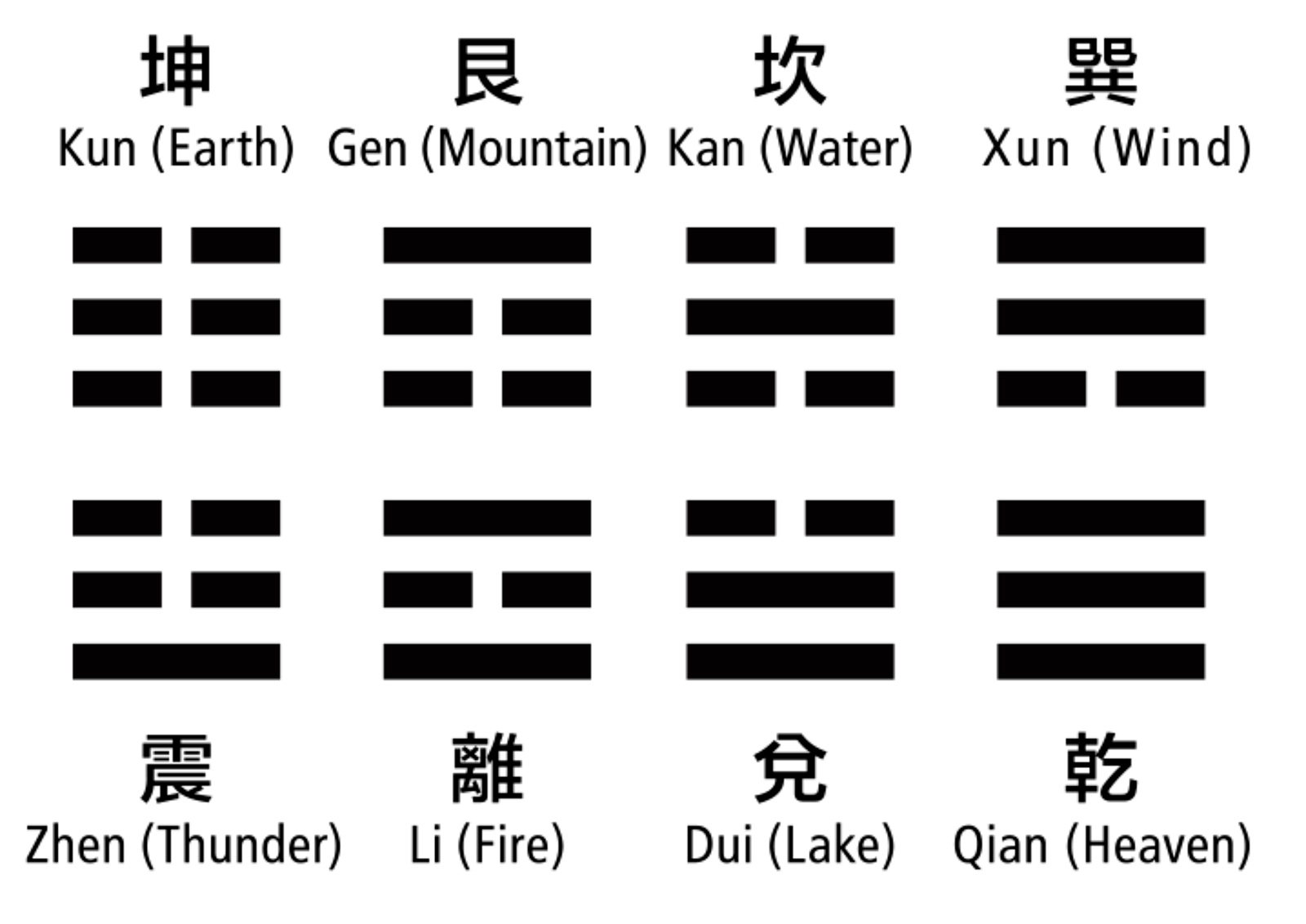
From these building blocks of the cosmos, Fu Xi devolved all aspects of civilization—kingship, marriage, writing, navigation, agriculture—all of which he taught to his human descendants.
Here mythology turns into legend. Around the year 1050 BCE, according to the tradition, Emperor Wen, founder of the Zhou dynasty, doubled the trigrams to hexagrams (six-lined figures), numbered and arranged all of the possible combinations—there are 64—and gave them names. He wrote brief oracles for each that have since been known as the “Judgments.” His son, the Duke of Zhou, a poet, added gnomic interpretations for the individual lines of each hexagram, known simply as the “Lines.” It was said that, five hundred years later, Confucius himself wrote ethical commentaries explicating each hexagram, which are called the “Ten Wings” (“wing,” that is, in the architectural sense).
The archaeological and historical version of this narrative is far murkier. In the Shang dynasty (which began circa 1600 BCE) or possibly even earlier, fortune-telling diviners would apply heat to tortoise shells or the scapulae of oxen and interpret the cracks that were produced. Many of these “oracle bones”—hundreds of thousands of them have been unearthed—have complete hexagrams or the numbers assigned to hexagrams incised on them. Where the hexagrams came from, or how they were interpreted, is completely unknown.
Sometime in the Zhou dynasty—the current guess is around 800 BCE—the 64 hexagrams were named, and a written text was established, based on the oral traditions. The book became known as the Zhou Yi (Zhou Changes). The process of consultation also evolved from the tortoise shells, which required an expert to perform and interpret, to the system of coins or yarrow stalks that anyone could practice and that has been in use ever since. Three coins, with numbers assigned to heads or tails, were simultaneously tossed; the resulting sum indicated a solid or broken line; six coin tosses thus produced a hexagram. In the case of the yarrow stalks, 50 were counted out in a more laborious procedure to produce the number for each line.
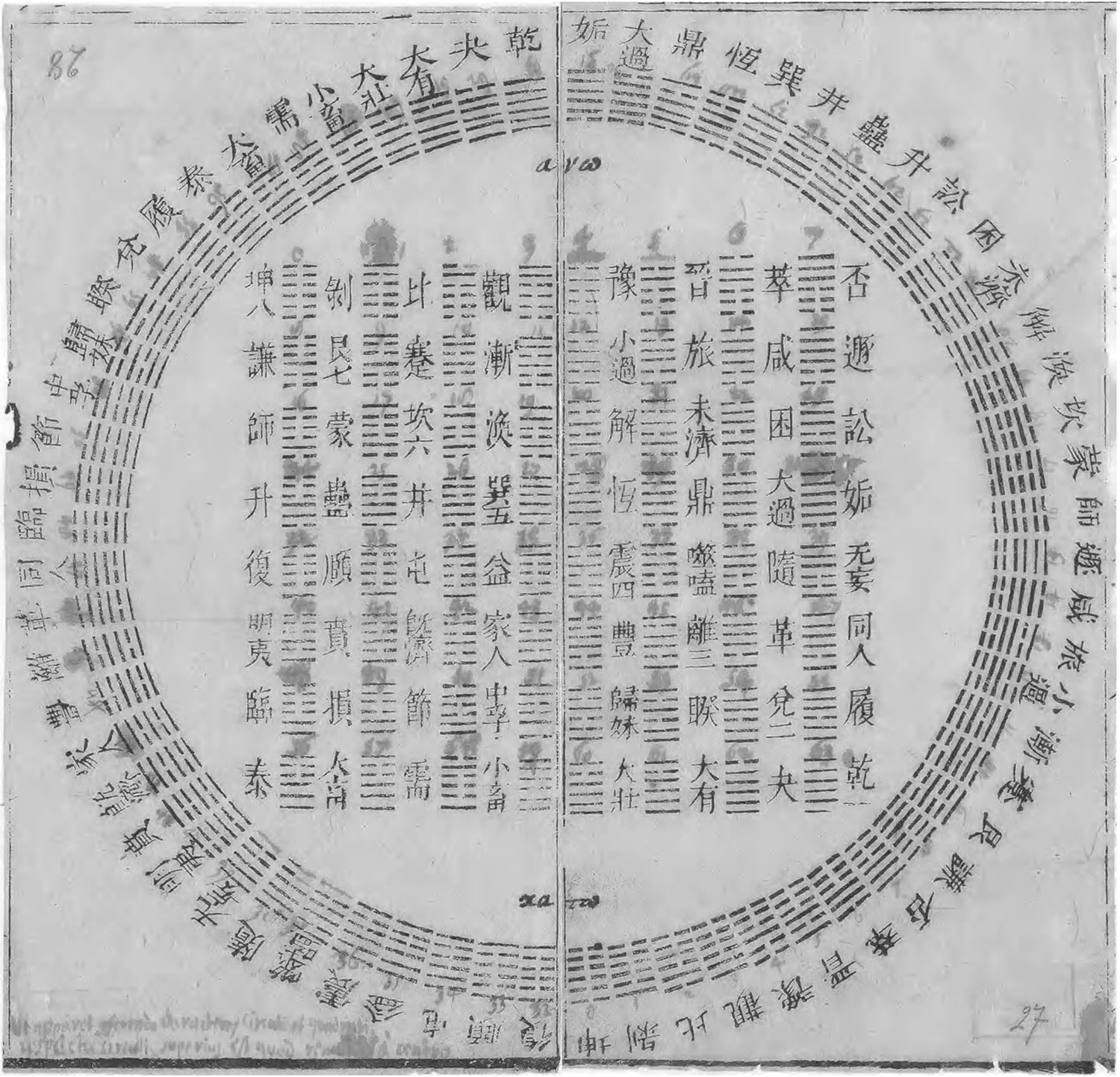
By the third century BCE, with the rise of Confucianism, the “Ten Wings” commentaries had been added, transforming the Zhou Yi from a strictly divinatory manual to a philosophical and ethical text. In 136 BCE, Emperor Wu of the Han dynasty declared it the most important of the five canonical Confucian books and standardized the text from among various competing versions (some with the hexagrams in a different order). This became the I Ching, the Book (or Classic) of Change, and its format has remained the same since: a named and numbered hexagram, an arcane “Judgment” for that hexagram, an often poetic interpretation of the image obtained by the combination of the two trigrams, and enigmatic statements on the meaning of each line of the hexagram. Confucius almost certainly had nothing to do with the making of the I Ching, but he did supposedly say that if he had another hundred years to live, 50 of them would be devoted to studying it.
For two millennia, the I Ching was the essential guide to the universe. In a philosophical cosmos where everything is connected and everything is in a state of restless change, the book was not a description of the universe but rather its most perfect microcosm. It represented, as one Sinologist has put it, the “underpinnings of reality.” Its 64 hexagrams became the irrevocable categories for countless disciplines. Its mysterious “Judgments” were taken as kernels of thought to be elaborated, in the “Ten Wings” and countless commentaries, into advice to rulers on how to run an orderly state and to ordinary people on how to live a proper life. It was a tool for meditation on the cosmos and, as a seamless piece of the way of the world, it also revealed what would be auspicious or inauspicious for the future.
In the West, the I Ching was discovered in the late 17th century by Jesuit missionaries in China, who decoded the text to reveal its Christian universal truth: hexagram number one was God; two was the second Adam, Jesus; three was the Trinity; eight was the members of Noah’s family; and so on. Leibniz enthusiastically found the universality of his binary system in the solid and broken lines. Hegel—who thought Confucius was not worth translating—considered the book “superficial”: “There is not to be found in one single instance a sensuous conception of universal natural or spiritual powers.”
The first English translation was done by Canon Thomas McClatchie, an Anglican cleric in Hong Kong. McClatchie was a Reverend Casaubon figure who, in 1876, four years after the publication of Middlemarch, found the key to all mythologies and asserted that the I Ching had been brought to China by one of Noah’s sons and was a pornographic celebration of a “hermaphroditic monad,” elsewhere worshiped among the Chaldeans as Baal and among Hindus as Shiva. James Legge, also a missionary in Hong Kong and, despite a general loathing of China, the first important English-language translator of the Chinese classics, considered McClatchie “delirious.” After 20 interrupted years of work—the manuscript was lost in a shipwreck in the Red Sea—Legge produced the first somewhat reliable English translation of the I Ching in 1882, and the one that first applied the English word for a six-pointed star, “hexagram,” to the Chinese block of lines.
Professionally appalled by what he considered its idolatry and superstition, Legge nevertheless found himself “gradually brought under a powerful fascination,” and it led him to devise a novel theory of translation. Since Chinese characters were not, he claimed, “representations of words, but symbols of ideas,” therefore “the combination of them in composition is not a representation of what the writer would say, but of what he thinks.” The translator, then, must become “en rapport” with the author, and enter into a “seeing of mind to mind,” a “participation” in the thoughts of the author that goes beyond what the author merely said. Although the I Ching has no author, Legge’s version is flooded with explanations and clarifications parenthetically inserted into an otherwise literal translation of the text.
Herbert Giles, the next important English-language translator after Legge, thought the I Ching was “apparent gibberish”: “This is freely admitted by all learned Chinese, who nevertheless hold tenaciously to the belief that important lessons could be derived from its pages if only we had the wit to understand them.” Arthur Waley, in a 1933 study—he never translated the entire book—described it as a collection of “peasant interpretation” omens to which specific divinations had been added at a later date. Thus, taking a familiar Western example, he wrote that the omen “red sky in the morning, shepherds take warning” would become the divination “red sky in the morning: inauspicious; do not cross the river.”
Waley proposed three categories of omens—“inexplicable sensations and involuntary movements (‘feelings,’ twitchings, stumbling, belching and the like)…those concerning plants, animals and birds…[and] those concerning natural phenomena (thunder, stars, rain etc.)”—and found examples of all of them in his decidedly unmetaphysical reading of the book. Joseph Needham devoted many exasperated pages to the I Ching in Science and Civilization in China as a “pseudo-science” that had, for centuries, a deleterious effect on actual Chinese science, which attempted to fit exact observations of the natural and physical worlds into the “cosmic filing-system” of the vague categories of the hexagrams.
It was Richard Wilhelm’s 1924 German translation of the I Ching and especially the English translation of the German by the Jungian Cary F. Baynes in 1950 that transformed the text from Sinological arcana to international celebrity. Wilhelm, like Legge, was a missionary in China, but unlike Legge was an ardent believer in the Wisdom of the East, with China the wisest of all. The “relentless mechanization and rationalization of life in the West” needed the “Eastern adhesion to a natural profundity of soul.” His mission was to “join hands in mutual completion,” to uncover the “common foundations of humankind” in order to “find a core in the innermost depth of the humane, from where we can tackle…the shaping of life.”
Wilhelm’s translation relied heavily on late, Song Dynasty Neo-Confucian interpretations of the text. In the name of universality, specifically Chinese referents were given general terms, and the German edition had scores of footnotes noting “parallels” to Goethe, Kant, the German Romantics, and the Bible. (These were dropped for the English-language edition.) The text was oddly presented twice: the first time with short commentaries, the second time with more extended ones. The commentaries were undifferentiated amalgams of various Chinese works and Wilhelm’s own meditations. (Needham thought that the edition belonged to the “Department of Utter Confusion”: “Wilhelm seems to be the only person…who knew what it was all about.”)
The book carried an introduction by Carl Jung, whom Wilhelm considered “in touch with the findings of the East [and] in accordance with the views of the oldest Chinese wisdom.” (One proof was Jung’s male and female principles, the anima and the animus, which Wilhelm connected to yin and yang.) Some of Jung’s assertions are now embarrassing. (“It is a curious fact that such a gifted and intelligent people as the Chinese have never developed what we call science.”) But his emphasis on chance—or synchronicity, the Jungian, metaphysical version of chance—as the guiding principle for a sacred book was, at the time, something unexpected, even if, for true believers, the I Ching does not operate on chance at all.
The Wilhelm/Baynes Bollingen edition was a sensation in the 1950s and 1960s. Octavio Paz, Allen Ginsberg, Jorge Luis Borges, and Charles Olson, among many others, wrote poems inspired by its poetic language. Fritjof Capra in The Tao of Physics used it to explain quantum mechanics and Terence McKenna found that its geometrical patterns mirrored the “chemical waves” produced by hallucinogens. Others considered its binary system of lines a prototype for the computer. Philip K. Dick and Raymond Queneau based novels on it; Jackson Mac Low and John Cage invented elaborate procedures using it to generate poems and musical compositions.
It is not difficult to recuperate how thrilling the arrival of the I Ching was both to the avant-gardists, who were emphasizing process over product in art, and to the anti-authoritarian counterculturalists. It brought, not from the soulless West, but from the mysterious East, what Wilhelm called “the seasoned wisdom of thousands of years.” It was an ancient book without an author, a cyclical configuration with no beginning or end, a religious text with neither exotic gods nor priests to whom one must submit, a do-it-yourself divination that required no professional diviner. It was a self-help book for those who wouldn’t be caught reading self-help books, and moreover one that provided an alluring glimpse of one’s personal future. It was, said Bob Dylan, “the only thing that is amazingly true.”
The two latest translations of the I Ching couldn’t be more unalike; they are a complementary yin and yang of approaches. John Minford is a scholar best known for his work on the magnificent five-volume translation of The Story of the Stone (or The Dream of the Red Chamber), universally considered the greatest Chinese novel, in a project begun by the late David Hawkes. His I Ching, obviously the result of many years of study, is over 800 pages long, much of it in small type, and encyclopedic. Minford presents two complete translations: the “Bronze Age Oracle,” a recreation of the Zhou dynasty text before any of the later Confucian commentaries were added to it, and the “Book of Wisdom,” the text as it was elucidated in the subsequent centuries. Each portion of the entries for each hexagram is accompanied by an exegesis that is a digest of the historical commentaries and the interpretations by previous translators, as well as reflections by Minford himself that link the hexagram to Chinese poetry, art, ritual, history, philosophy, and mythology. It is a tour de force of erudition, almost a microcosm of Chinese civilization, much as the I Ching itself was traditionally seen.
David Hinton is, with Arthur Waley and Burton Watson, the rare example of a literary Sinologist—that is, a classical scholar thoroughly conversant with, and connected to, contemporary literature in English. A generation younger than Watson, he and Watson are surely the most important American translators of Chinese classical poetry and philosophy in the last 50 years. Both are immensely prolific, and both have introduced entirely new ways of translating Chinese poetry. Hinton’s I Ching is equally inventive. It is quite short, with only two pages allotted to each hexagram, presents a few excerpts from the original “Ten Wings” commentaries, but has nothing further from Hinton himself, other than a short introduction. Rather than consulted, it is meant to be read cover to cover, like a book of modern poetry—though it should be quickly said that this is very much a translation, and not an “imitation” or a postmodern elaboration. Or perhaps its fragments and aphorisms are meant to be dipped into at random, the way one reads E.M. Cioran or Elias Canetti.
Hinton adheres to a Taoist or Ch’an (Zen) Buddhist reading of the book, unconcerned with the Confucian ethical and political interpretations. His I Ching puts the reader into the Tao of nature: that is, the way of the world as it is exemplified by nature and embodied by the book. He takes the mysterious lines of the judgments as precursors to the later Taoist and Ch’an writings: “strategies…to tease the mind outside workaday assumptions and linguistic structures, outside the limitations of identity.” The opposite of Wilhelm’s Jungian self-realization, it is intended as a realization of selflessness. Moreover, it is based on the belief that archaic Chinese culture, living closer to the land—and a land that still had a great deal of wilderness—was less estranged from nature’s Tao.
To that end, Hinton occasionally translates according to a pictographic reading of the oldest characters, a technique first used by Ezra Pound in his idiosyncratic and wonderful version of the earliest Chinese poetry anthology, the Book of Songs, which he titled The Confucian Odes. For example, Hinton calls Hexagram 32—usually translated as “Endurance” or “Duration” or “Perseverance”—“Moondrift Constancy,” because the character portrays a half-moon fixed in place with a line above and below it. The character for “Observation” becomes “Heron’s-Eye Gaze,” for indeed it has a heron and an eye in it, and nothing watches more closely than a waterbird. Hinton doesn’t do this kind of pictographic reading often, but no doubt Sinologists will be scandalized.
The difference between the two translations—the differences among all translations—is apparent if we look at a single hexagram: number 52, called Gen.

Minford translates the name as “Mountain” for the hexagram is composed of the two Mountain trigrams, one on top of the other. His translation of the text throughout the book is minimalist, almost telegraphese, with each line centered, rather than flush left. He has also made the exceedingly strange decision to incorporate tags in Latin, taken from the early Jesuit translations, which he claims
can help us relate to this deeply ancient and foreign text, can help create a timeless mood of contemplation, and at the same time can evoke indirect connections between the Chinese traditions of Self-Knowledge and Self-Cultivation…and…the long European tradition of Gnosis and spiritual discipline.
In the “Book of Wisdom” section, he translates the “Judgment” for Hexagram 52 as:
The back
Is still
As a Mountain;
There is no body.
He walks
In the courtyard,
Unseen.
No Harm,
Nullum malum.
This is followed by a long and interesting exegesis on the spiritual role and poetic image of mountains in the Chinese tradition.
Hinton calls the hexagram “Stillness” and translates into prose: “Stillness in your back. Expect nothing from your life. Wander the courtyard where you see no one. How could you ever go astray?”
Wilhelm has “Keeping Still, Mountain” as the name of the hexagram. His “Judgment” reads:
KEEPING STILL. Keeping his back still
So that he no longer feels his body.
He goes into the courtyard
And does not see his people.
No blame.
He explains:
True quiet means keeping still when the time has come to keep still, and going forward when the time has come to go forward. In this way rest and movement are in agreement with the demands of the time, and thus there is light in life.
The hexagram signifies the end and beginning of all movement. The back is named because in the back are located all the nerve fibers that mediate movement. If the movement of these spinal nerves is brought to a standstill, the ego, with its restlessness, disappears as it were. When a man has thus become calm, he may turn to the outside world. He no longer sees in it the struggle and tumult of individual beings, and therefore he has that true peace of mind which is needed for understanding the great laws of the universe and for acting in harmony with them. Whoever acts from these deep levels makes no mistakes.
The Columbia University Press I Ching, translated by Richard John Lynn and billed as the “definitive version” “after decades of inaccurate translations,” has “Restraint” for Gen: “Restraint takes place with the back, so one does not obtain [sic] the other person. He goes into that one’s courtyard but does not see him there. There is no blame.” Lynn’s odd explanation, based on the Han dynasty commentator Wang Bi, is that if two people have their backs turned, “even though they are close, they do not see each other.” Therefore neither restrains the other and each exercises self-restraint.
The six judgments for the six individual lines of Hexagram 52 travel through the body, including the feet, calves, waist, trunk, and jaws. (Wilhelm weirdly and ahistorically speculates that “possibly the words of the text embody directions for the practice of yoga.”) Thus, for line 2, Hinton has: “Stillness fills your calves. Raise up succession, all that will follow you, or you’ll never know contentment.”
Minford translates it as: “The calves are/Still as a Mountain./Others/Are not harnessed./The heart is heavy.” He explains: “There is a potential healing, a Stillness. But the Energy of Others…cannot be mastered and harnessed. No Retreat is possible, only a reluctant acceptance. One lacks the foresight for Retreat. Beware.”
Wilhelm’s version is: “Keeping his calves still./He cannot rescue him whom he follows./His heart is not glad.” This is glossed as:
The leg cannot move independently; it depends on the movement of the body. If a leg is suddenly stopped while the whole body is in vigorous motion, the continuing body movement will make one fall.
The same is true of a man who serves a master stronger than himself. He is swept along, and even though he himself may halt on the path of wrongdoing, he can no longer check the other in his powerful movement. When the master presses forward, the servant, no matter how good his intentions, cannot save him.
In the “Bronze Age Oracle” section—the original Zhou book without the later interpretations—Minford translates Gen as “Tending,” believing that it refers to traditional medicine and the need to tend the body. The “Judgment” for the entire hexagram reads: “The back/Is tended,/The body/Unprotected./He walks/In an empty courtyard./No Harm.” He suggests that the “empty courtyard” is a metaphor for the whole body, left untended. His judgement for the second line is: “The calves/Are tended./There is/No strength/In the flesh./The heart/Is sad,” which he glosses as “There is not enough flesh on the calves. Loss of weight is a concern, and it directly affects the emotions.”
Both Richard J. Smith, in a monograph on the I Ching for the Princeton Lives of Great Religious Books series, and Arthur Waley take the hexagram back to the prevalent practice in the Shang dynasty of human and animal sacrifice. Smith translates Gen as “cleave” (but, in an entirely different reading, says that the word might also mean “to glare at”). His “Judgment” is puzzling: “If one cleaves the back he will not get hold of the body; if one goes into the courtyard he will not see the person. There will be no misfortune.” But his reading of line two is graphic: “Cleave the lower legs, but don’t remove the bone marrow. His heart is not pleased.”
Waley thinks Gen means “gnawing,” and “evidently deals with omen-taking according to the way in which rats, mice or the like have deals with the body of the sacrificial victim when exposed as ‘bait’ to the ancestral spirit.” His “Judgment” is: “If they have gnawed its back, but not possessed themselves of the body,/It means that you will go to a man’s house, but not find him at home.” He reads line two as: “If they gnaw the calf of the leg, but don’t pull out the bone marrow, their (i.e. the ancestors’) hearts do not rejoice.”
What is certain is that Hexagram 52 is composed of two Mountain trigrams and has something to do with the back and something to do with a courtyard that is either empty or where the people in it are not seen. Otherwise, these few lines may be about stillness, having no expectations, self-restraint, peace of mind, knowing when not to follow a leader, the care of various aches and pains, glaring at things, and the preparations for, and results of, human or animal sacrifices.

.png)


Comments
Post a Comment